Much as I love J.J. Abrams, I can't say I had high expectations for Revolution, a new drama series about the aftermath of a worldwide blackout. In short, people have had to learn to live without electricity—and all the things we've come to depend upon electricity for. Still, for J.J.'s sake, I wanted to give this one a try. It premiers on Monday, September 17th, but if you have Hulu, you can go watch it now. NOW!
It seems we may finally have a worthy successor to the Lost mantel. Revolution is steadily paced but doesn't tarry. The characters do border on stereotype, but the plot is interesting enough to buoy the show on the whole. Because as it turns out, Revolution is about far more than dealing with a lack of video games or iceboxes. There is a mythology here, held in the center of the show like a dark pearl. I'm not going to spoil it for you, but the reveal near the end of the pilot episode ups the interest level quite a bit.
And then there's just the fun of watching people fight with crossbows and swords. So we've got some Buffy and Highlander kinds of stuff going on there, too. Though the wardrobe choices were definitely more informed by Firefly. And seeing that the pilot was written by the guy who created Supernatural . . . Well, that shows, too. So this should appeal to fans of all sorts.
In short, I definitely recommend giving this one a try. I'm crossing fingers and toes it won't get canceled before it can live up to its potential. Revolution has made my "must" list for viewing this season.
9.13.2012
Book Review: The Real Elizabeth: An Intimate Portrait of Queen Elizabeth II
Andrew Marr
Henry Holt & Co, 2012
368 pages
Hardbound
_______________________________________
I don't think I ever planned or expected to read a book about Queen Elizabeth II. But I was at the library doing research for some other stuff, and for some reason this book jumped out at me (no, not literally, the library seldom gets so exciting). And I saw it was recently published, and so in my mind it was also relatively up-to-date, and I decided to give it a try.
Elizabeth II has been Queen of England for as long as my mother and I have been alive and almost as long as my father has been. That's quite the perspective for you. It's hard for me to imagine a world in which Elizabeth II is not queen, perhaps because it's hard for me to imagine Charles as king, but whatever. It will happen eventually. That's what The Real Elizabeth sort of brought home to me, really. It's not something I'm inclined to think about much, but Marr's book gives such a detailed accounting of the way Elizabeth II handles her affairs, and one knows Charles is likely to do things very differently. Elizabeth has weathered many storms in her time as queen, and one can't help but wonder if Charles will find his own path to success.
Though of course The Real Elizabeth is based mostly on historical record and a few quotes from those who've worked for and with the queen, Marr still manages to paint a portrait of Her Majesty that gives the reader a pretty solid idea of what she must be like as a person. He also does a nice job of couching key events in her reign in political and historical context. The sum total is, naturally, a sort of defense of the monarchy as an institution, tempered by the acknowledgment that the monarchy must change with the times if it is going to continue. All in all a very safe book, but still a fine read. (I especially liked the chapter about the Britannia. I'll admit to having skipped the chapter about money.)
I always feel a little gawkish when reading a book about a current person, someone still alive or only recently deceased; there is a voyeuristic aspect to the whole thing. But maybe that's also true of books about people long dead . . . Why else read a biography except to get the scoop on someone? Biographies were, I suppose, the original form of reality programming. The Real Elizabeth is a pretty decent one, at any rate, and nothing you have to feel embarrassed about being caught with.
9.10.2012
Television: Parade's End (Episode 3/5)
There's no one to like in this program, and I think that's what really bothers me. (That was the very reason I couldn't be bothered to finish Gone Girl by Gillian Flynn, either; I just wanted everyone to die.) What's worse, I think I'm supposed to maybe feel sympathetic toward or sorry for Christopher and Val, as if they have some kind of true love connection that's being denied them by convention and the fact they are both, at heart, very good people, but . . . No.
If anything, I feel bad for Sylvia, which sounds insane except that I absolutely understand her. She is childish in her attempts to manipulate some kind of action from her husband, but I can at least understand her motivation. She's looking for some show of affection from Christopher, she wants to prompt him into feeling. Anything would be better than his seeming indifference to her. That makes sense, even if Sylvia's methods leave much to be desired. She's tried to make him jealous, she's tried to be "good" by being chaste, but there seems to be no pleasing him. She cannot please him, he does not want her, so her frustration is valid.
But God, the whole Christopher and Val thing is insipid. I cannot like the way the story gives them carte blanche to take up with one another—Sylvia practically gives Christopher permission, and then Christopher's brother Mark even strives to arrange for it—even if it doesn't come to pass. It's not because they've stopped themselves, only because they've been prevented, so there's no saving grace in the lack of consummation. It's something of a hypocritical story in turning Sylvia into a beast for her indiscretions but making it okay for Christopher. Is it because he's supposedly really, truly in love? That makes it worse, not better. A woman might be able to forgive a man who strayed once or twice, so long as his heart is at home. Emotional affairs, however, are not to be countenanced.
Anyway, at this point I'd rather Christopher get a bullet in the head at the front lines or something. Put us all out of his misery.
If anything, I feel bad for Sylvia, which sounds insane except that I absolutely understand her. She is childish in her attempts to manipulate some kind of action from her husband, but I can at least understand her motivation. She's looking for some show of affection from Christopher, she wants to prompt him into feeling. Anything would be better than his seeming indifference to her. That makes sense, even if Sylvia's methods leave much to be desired. She's tried to make him jealous, she's tried to be "good" by being chaste, but there seems to be no pleasing him. She cannot please him, he does not want her, so her frustration is valid.
But God, the whole Christopher and Val thing is insipid. I cannot like the way the story gives them carte blanche to take up with one another—Sylvia practically gives Christopher permission, and then Christopher's brother Mark even strives to arrange for it—even if it doesn't come to pass. It's not because they've stopped themselves, only because they've been prevented, so there's no saving grace in the lack of consummation. It's something of a hypocritical story in turning Sylvia into a beast for her indiscretions but making it okay for Christopher. Is it because he's supposedly really, truly in love? That makes it worse, not better. A woman might be able to forgive a man who strayed once or twice, so long as his heart is at home. Emotional affairs, however, are not to be countenanced.
Anyway, at this point I'd rather Christopher get a bullet in the head at the front lines or something. Put us all out of his misery.
9.03.2012
Television: Parade's End (Episode 2/5)
Okay, I really do just have to say I don't see how even one woman could be in love with this Christopher fellow, much less two. (We are supposed to believe both his wife and that girl are in love with him, aren't we?) He's such an insufferable sop. Perhaps knowing what's coming is part of my problem, as I can't countenance that kind of misbehavior. I understand his wife was unfaithful, but she's begun to rectify that, and two wrongs and all that.
In any case, I made this episode much more entertaining by pretending it was all about doughnuts. If you take all those lingering shots of people's expressions (particularly Cumberbatch's, but others' as well), and imagine they are reacting to doughnuts—or a lack thereof—it makes the whole thing really quite fun to watch. Perhaps I'll carry on in the next episode by pretending the entire war is over doughnuts. Or maybe I'll imagine Hugh Laurie and Rowan Atkinson showing up in the trenches. That could be a good time.
Then again, I get the sense we might not actually see much of the war itself in this. Which is fine because (a) I don't much like war shows/stories, and (b) this Christopher stands to be the Worst. Soldier. Ever. . . Gag. He's already the worst husband and/or would-be lover and probably father or whatever, so . . . Why is there a whole five-hour show about him exactly?
Or maybe the real question is, why am I watching it?
Well, that's easy. I'm watching it for the doughnuts.
In any case, I made this episode much more entertaining by pretending it was all about doughnuts. If you take all those lingering shots of people's expressions (particularly Cumberbatch's, but others' as well), and imagine they are reacting to doughnuts—or a lack thereof—it makes the whole thing really quite fun to watch. Perhaps I'll carry on in the next episode by pretending the entire war is over doughnuts. Or maybe I'll imagine Hugh Laurie and Rowan Atkinson showing up in the trenches. That could be a good time.
Then again, I get the sense we might not actually see much of the war itself in this. Which is fine because (a) I don't much like war shows/stories, and (b) this Christopher stands to be the Worst. Soldier. Ever. . . Gag. He's already the worst husband and/or would-be lover and probably father or whatever, so . . . Why is there a whole five-hour show about him exactly?
Or maybe the real question is, why am I watching it?
Well, that's easy. I'm watching it for the doughnuts.
8.25.2012
Television: Parade's End (Episode 1/5)
It's no secret I like Benedict Cumberbatch. Or I did like him once. I can't decide now whether I still do.
I also like Tom Stoppard, for what it's worth. I'm not so familiar with Ford Madox Ford's work, but I looked him up and was happy to see he and I have the same birthday (though not the same year, as you might guess, because I am not old and dead).
Anyway, I usually also enjoy period pieces. Not war stories so much, but this first installment of Parade's End does not yet feature the beginning of World War I. And still, despite the lovely art direction, I found my attention wandering here. I mostly had the sense they'd given Cumberbatch a bit too much to carry, and the whole of the thing might have done better to spread its weight over other characters. Benny's lovely to look at (aside from a weak chin), but I'm starting to have the feeling he does a lot of the same kind of thing, plays a lot of the same kind of character(s) across many movies and shows. It does make me curious about Star Trek, though. Maybe that will be different.
Too, I'm beginning to notice a lot of his acting is done via a specific set of facial expressions. And that most of these are made by his moving his mouth in certain ways.
The problem is, once you see these things, you can't not see them and they become distracting. I suppose I could try to trick myself into believing it was all in my head and attempt to view the next installment with a fresh eye. I do intend to watch more in any case. I'm sort of hoping I'm wrong and that my first impression is off the mark. But I don't have the knack for simply liking something (or someone) because I want to like it (him/her). I can't help but think honestly and critically (something many fans lack the ability to do). Maybe it's the years of film school, but really I think I was always this way.
To sum up, I'd say it's a mediocre start. But I'll stick it out in hopes it gets better.
I also like Tom Stoppard, for what it's worth. I'm not so familiar with Ford Madox Ford's work, but I looked him up and was happy to see he and I have the same birthday (though not the same year, as you might guess, because I am not old and dead).
Anyway, I usually also enjoy period pieces. Not war stories so much, but this first installment of Parade's End does not yet feature the beginning of World War I. And still, despite the lovely art direction, I found my attention wandering here. I mostly had the sense they'd given Cumberbatch a bit too much to carry, and the whole of the thing might have done better to spread its weight over other characters. Benny's lovely to look at (aside from a weak chin), but I'm starting to have the feeling he does a lot of the same kind of thing, plays a lot of the same kind of character(s) across many movies and shows. It does make me curious about Star Trek, though. Maybe that will be different.
Too, I'm beginning to notice a lot of his acting is done via a specific set of facial expressions. And that most of these are made by his moving his mouth in certain ways.
The problem is, once you see these things, you can't not see them and they become distracting. I suppose I could try to trick myself into believing it was all in my head and attempt to view the next installment with a fresh eye. I do intend to watch more in any case. I'm sort of hoping I'm wrong and that my first impression is off the mark. But I don't have the knack for simply liking something (or someone) because I want to like it (him/her). I can't help but think honestly and critically (something many fans lack the ability to do). Maybe it's the years of film school, but really I think I was always this way.
To sum up, I'd say it's a mediocre start. But I'll stick it out in hopes it gets better.
8.24.2012
Best Restaurant Meals
I was trying to remember all the best meals I've eaten at various restaurants through the ages. I don't think I could hope to rank them discreetly, so I'm going to list them chronologically.
Honorable Mentions:
Hmm. From this list you'd think I like Italian/Tuscan food more than I really do. It's not the kind of thing that usually tops my list, but when I do go for this kind of cuisine, I aim high. I also really like Asian. And then steak and comfort foods.
The concentration of restaurants and meals in Boston and on the East Coast probably has much to do with the fact that I lived there so long. I'm sure I'll compile as impressive a list in California over time.
What I haven't included on these lists are the regular favorites that I have frequented and/or did frequent. Maybe I'll make up another list at a later time.
- [Texas Biergarten] - I don't know the name of this place because I was taken there as a child. It was a long drive out into the country of Central Texas, to a place in the middle of nowhere that was owned by a family. I had the best chicken fried steak of my life in that place.
- [Greek Ferry] - I was crossing from Brindisi to Corfu, and of all the places to have a great meal, I had one on this overnight ferry. Spaghetti and some kind of wine made by monks.
- Cafe Maddelena (Rome) - I had tortellini in a sort of tomato cream sauce, and I paid for my meal with a kiss. Really.
- Lala Rokh (Boston, MA) - Persian food. I don't even know what I ate, but I remember it was all fantastic.
- Gumbo Shop (New Orleans, LA) - This is a tourist stop, sure, but the locals also love it. I had catfish over a bed of seasoned spinach, and it was to die for. And of course they make wonderful bread pudding, too.
- Xcaret (Mexico) - I don't know which of the restaurants this was, but it was some of the best steak I've ever eaten. Plus, our server Guillermo was awesome.
- Spire (Boston, MA) - A fabulous meal, though the dessert—a sort of champagne parfait—was the real show stopper.
- Wall's (Savannah, GA) - Best barbecue, though almost impossible to find.
- Taranta (North End, Boston, MA) - A wonderful Italian meal, though what really made the night was the great wine (Planeta) that came with it.
- California Grill (Disney World, Orlando, FL) - The perfect blend of great food, great service, and a great view; our server even gave us a special hint so that we could go out and enjoy the fireworks without having to deal with the crowds.
- L'Andana (Burlington, MA) - More great Tuscan food and good wine.
- Tallulah on Thames (Newport, RI) - The best fresh butter and bread I've ever had, as well as great service in a charming setting.
- Acquerello (San Francisco, CA) - Wow. And then wow again. Some of the best service I've ever experienced, as well as some of the best food.
Honorable Mentions:
- Pierre Maspero's (New Orleans, LA) - I go here every time I go back to New Orleans. Solid food that never fails.
- Delta Grill (New York, NY) - Yummy homemade mac 'n' cheese and bread pudding.
- Angelina Cafe (New York, NY) - Because they always treat me right.
- Cafe George V (Paris) - I go here for the chocolate chaud.
- Cafe Erato (Athens) - A beautiful courtyard hung with ivy and featuring canaries in gilded cages. Oh, and the food was good, too.
- Thai Stick (Millbrae, CA) - Really good Thai food.
- Pho & I (Boston, MA) - Best drunken noodles and pad thai.
- Hula Hut (Austin, TX) - More for the atmosphere and experience than the food, however.
- Voodoo BBQ (New Orleans, LA) - My favorite barbecue in NO.
- Soho South Cafe (Savannah, GA) - More than "just a sandwich." Their motto is: "Where Food is an Art," and they mean it.
Hmm. From this list you'd think I like Italian/Tuscan food more than I really do. It's not the kind of thing that usually tops my list, but when I do go for this kind of cuisine, I aim high. I also really like Asian. And then steak and comfort foods.
The concentration of restaurants and meals in Boston and on the East Coast probably has much to do with the fact that I lived there so long. I'm sure I'll compile as impressive a list in California over time.
What I haven't included on these lists are the regular favorites that I have frequented and/or did frequent. Maybe I'll make up another list at a later time.
8.17.2012
Books: Fearless by Christine Rains
There is something somewhat Buffyesque about the protagonist (Abby) in this novella. She is one of the Fearless and has the supernatural power of helping small children defeat their (very real) monsters. In a unique turn, Rains has given Abby a stuffed hippo named Tawa as a spirit guide. (That explains the cover.)
Things get complicated when Abby rescues a handsome fae who in turn dedicates himself to paying back his blood debt . . . Mostly by getting in Abby's way when she's trying to work, and by occupying her thoughts when she should be trying to figure out why the number of monsters seems to be multiplying. The answer is an amusing stab at pop lit culture.
Fearless is a fun, quick read and I hope to see more of Rains' work in the future.
8.15.2012
Books: Star Signs Operating Manual by Calletta
This book is a little something different from my usual. It's "nonfiction" (if astrology counts as nonfiction) . . . And kind of a novelty. Basically, it's a collection of articles about the twelve zodiac signs and how to work and/or live with each personality type. The book is only available via Amazon Kindle at the moment, but depending on demand, it may roll out to other formats and devices at a later date.
8.03.2012
Book Review: Whispers Under Ground by Ben Aaronovitch
Ben Aaronovitch
Del Rey, 2012
Kindle
_______________________________________
Here, in the third installment of the Peter Grant series, Aaronovitch hits his stride. While I've really enjoyed all the books (Rivers of London (aka Midnight Riot) and Moon Over Soho coming before this one), I've enjoyed this one most.
For those unfamiliar with the series, Peter Grant is a police constable in London who has been assigned to the Folly—a branch designed to investigate and deal with the un- and supernatural. Which means that Peter is also a magician's apprentice. Hey, it takes fire to fight fire, so to speak.
Aaronovitch does a nice job building the mythology over the course of the books, though readers unfamiliar with London might do well to keep a map of the city next to their reading chairs. Regular references to Harry Potter, Tolkien, Doctor Who (for which Aaronovitch has written), Star Trek, and the like are nice touches of geek infusion. Aaronovitch does have a bad habit of telegraphing his plot twists, at least to anyone paying real attention. He does it less in Whispers than in the previous two books, however, and the whole of the story comes across as more organic overall.
I have an American Amazon/Kindle account, so I do wonder at the description and whether the book was heftily edited for American readers, since there was no play of FBI Agent Reynolds' religious beliefs in the version I read. Could it be they thought the whole born-again Christian thing might offend? (It wouldn't. And anyway, most really zealous Christians wouldn't be reading these books anyway. Not that that's ever stopped them from raising a ruckus.)
All in all, these books are my new favorite series and Aaronovitch can't write them fast enough to suit me. Also: when can we make this a television series?
7.24.2012
Books: Seating Arrangements by Maggie Shipstead
This isn't a review because I haven't finished reading the book yet. But although I'm enjoying the book, it has made me think . . .
The little author bio on the back flap of the book notes that Maggie Shipstead attended the Iowa Writers' Workshop. And I found myself thinking, Yes, this is exactly the kind of thing likely to come out of the Iowa Writers' Workshop. And that's not a bad thing, per se, just . . . [heave sigh here] It's all kind of the same, isn't it? What passes for "mainstream literary excellence," I mean. In this case it is a story of the days leading up to a wedding. It's something anyone might themselves live through, or observe, or even just imagine on their own without having to read someone else's imagining of it. It's the mediocrity of life packaged as something profound, when really it isn't. It's not even much of a story. It's just a collection of characters, their thoughts and feelings and interactions on paper. And it's written in a lovely way, and the characters have interesting moments (though I find none of them particularly compelling in whole), but still . . . I could go out and have my own thoughts and feelings and interactions and get more out of life than reading about these made-up ones.
Which is the problem with this type of literature. For me, anyway. It's sort of a waste on all sides: of the author's talent (surely she could write something truly profound instead of this minutiae that pretends to add up to something meaningful), and of the readers' time (because they could be out shopping at a market instead of reading a detailed description about it—one that takes longer to read than it would take a reader to, in fact, do his shopping). Never mind the enjoyment of reading such a book (as I said, I am enjoying it); enjoyment can be found in any number of places, after all, and not all of them are wastes such as this.
If a book is about escaping, about living the life of the protagonist as you travel along with him or her on his/her journeys, then reading a book in which nothing much happens, or reading a book in which life is ordinary, is pointless. Isn't it? Why not just go do for yourself? A good story takes you somewhere you can't go on your own. It turns you into the kind of person you can't be in everyday life. These literary novels seldom do that.
So I'll stick to the chick lit, and the fantasy and science fiction, the mystery, the historical novels, &c. Because these literary novels, so beloved by writing workshops and highbrowed critics, are boring.
The little author bio on the back flap of the book notes that Maggie Shipstead attended the Iowa Writers' Workshop. And I found myself thinking, Yes, this is exactly the kind of thing likely to come out of the Iowa Writers' Workshop. And that's not a bad thing, per se, just . . . [heave sigh here] It's all kind of the same, isn't it? What passes for "mainstream literary excellence," I mean. In this case it is a story of the days leading up to a wedding. It's something anyone might themselves live through, or observe, or even just imagine on their own without having to read someone else's imagining of it. It's the mediocrity of life packaged as something profound, when really it isn't. It's not even much of a story. It's just a collection of characters, their thoughts and feelings and interactions on paper. And it's written in a lovely way, and the characters have interesting moments (though I find none of them particularly compelling in whole), but still . . . I could go out and have my own thoughts and feelings and interactions and get more out of life than reading about these made-up ones.
Which is the problem with this type of literature. For me, anyway. It's sort of a waste on all sides: of the author's talent (surely she could write something truly profound instead of this minutiae that pretends to add up to something meaningful), and of the readers' time (because they could be out shopping at a market instead of reading a detailed description about it—one that takes longer to read than it would take a reader to, in fact, do his shopping). Never mind the enjoyment of reading such a book (as I said, I am enjoying it); enjoyment can be found in any number of places, after all, and not all of them are wastes such as this.
If a book is about escaping, about living the life of the protagonist as you travel along with him or her on his/her journeys, then reading a book in which nothing much happens, or reading a book in which life is ordinary, is pointless. Isn't it? Why not just go do for yourself? A good story takes you somewhere you can't go on your own. It turns you into the kind of person you can't be in everyday life. These literary novels seldom do that.
So I'll stick to the chick lit, and the fantasy and science fiction, the mystery, the historical novels, &c. Because these literary novels, so beloved by writing workshops and highbrowed critics, are boring.
7.20.2012
Books: Redshirts by John Scalzi
John Scalzi
Tor, 2012
Kindle
_______________________________________
Just finished reading this one on my Kindle, and it was a lot of fun. In the way that, you know, movies where ridiculous coincidences happen can be fun. Except in Redshirts the ridiculous coincidences are kind of the point. Kind of, but not exactly.
Science fiction fans (especially of the Star Trek variety, though the nomenclature has leaked out over the genre as a whole, as these things will do) will understand immediately was is meant by the title. For those of you who may not, allow me to explain: a "redshirt" is a short-lived crewman on the original Star Trek series (and sometimes appearing in subsequent series), someone not known to the audience as a regular character. This person would end up accompanying main characters on an away team mission, or in some other dangerous situation, and inevitably end up dying. Another common name for them is "expendable crewman/crew member."
So without giving too many of the plot twists away, it's at least safe to say Redshirts is about a group of second-string members on a starship and their attempts to keep from getting killed off.
It's a cute, quick read, funny and pithy. Scalzi knows from sci-fi; besides being an author, he worked on Stargate: Universe, so he understands the structure of the sci-fi television universe and puts that knowledge to good use here. Attempts to be touching in Redshirts fall a little flat, and the coda go on a bit too long, but overall a very fine read, perfectly light for summer.
Tor, 2012
Kindle
_______________________________________
Just finished reading this one on my Kindle, and it was a lot of fun. In the way that, you know, movies where ridiculous coincidences happen can be fun. Except in Redshirts the ridiculous coincidences are kind of the point. Kind of, but not exactly.
Science fiction fans (especially of the Star Trek variety, though the nomenclature has leaked out over the genre as a whole, as these things will do) will understand immediately was is meant by the title. For those of you who may not, allow me to explain: a "redshirt" is a short-lived crewman on the original Star Trek series (and sometimes appearing in subsequent series), someone not known to the audience as a regular character. This person would end up accompanying main characters on an away team mission, or in some other dangerous situation, and inevitably end up dying. Another common name for them is "expendable crewman/crew member."
So without giving too many of the plot twists away, it's at least safe to say Redshirts is about a group of second-string members on a starship and their attempts to keep from getting killed off.
It's a cute, quick read, funny and pithy. Scalzi knows from sci-fi; besides being an author, he worked on Stargate: Universe, so he understands the structure of the sci-fi television universe and puts that knowledge to good use here. Attempts to be touching in Redshirts fall a little flat, and the coda go on a bit too long, but overall a very fine read, perfectly light for summer.
7.12.2012
Music: Matchbox Twenty's Album Art for North
Matchbox Twenty unveiled the cover for their latest album, North, which is due out September 4 (their first single "She's So Mean" is already all over the radio).

Bravo to the guys for showing their faces this time, I suppose. (It's weird; I had a dream a month or so back about MB20 in the top room of an ornate building, and I was out in the parking lot looking up at the window . . . ::shrug::)
The whole thing is rather stark and somewhat antiseptic. Reminds me of high school newspaper and yearbook, discussions of "white space" and so forth. I dig the reflections in the windows, though.

Bravo to the guys for showing their faces this time, I suppose. (It's weird; I had a dream a month or so back about MB20 in the top room of an ornate building, and I was out in the parking lot looking up at the window . . . ::shrug::)
The whole thing is rather stark and somewhat antiseptic. Reminds me of high school newspaper and yearbook, discussions of "white space" and so forth. I dig the reflections in the windows, though.
7.05.2012
Books: What I'm Reading & What's On Deck
Right now I'm reading Redshirts by John Scalzi. I'll post a full-on review when I'm done, but sufficient to say I'm really enjoying it so far. I picked it up because I'm waiting for Ben Aaronovitch's new Peter Grant novel to come out (Whispers Under Ground, due to deliver to my Kindle on 31 July). I wish they'd turn Grant & Nightingale into a television series already. That would be every kind of awesome.
And yes, now I will use this space to remind you that my novella "St. Peter in Chains" can be found on Kindle, Smashwords, and iBooks, with the Nook version due out any day now. Go fill in your own blank spaces between books with that quick little read of mine.
And yes, now I will use this space to remind you that my novella "St. Peter in Chains" can be found on Kindle, Smashwords, and iBooks, with the Nook version due out any day now. Go fill in your own blank spaces between books with that quick little read of mine.
6.29.2012
Concert Review: Summerland Tour Kicks Off in Saratoga, CA
Five bands whose heydays were the 90s have joined forces to create one fun night of music. They are: Everclear, Sugar Ray, Gin Blossoms, Lit, and Marcy Playground.
One supposes the idea is that everyone of a certain age (I'm on the young side of this particular collective, but I still count) will know and remember at least some of these songs and bands and will probably enjoy pretty much all that is on offer. This was generally my experience at the concert. I love Gin Blossoms and really like Everclear and Sugar Ray, but before last night I couldn't have told you what Marcy Playground or Lit were known for. This led to many, "Oh! I know this song!" and "Oh! They play that song!" moments. Not entirely unpleasant, and it's always fun to be introduced to some new music among the favorites.
Marcy Playground started things off (the song you know by them if you don't own the album? "Sex and Candy"), always a tough spot to be in because of course the house isn't nearly full yet so it can seem like one is singing into a void. But they were really good (to me, someone who couldn't have identified them prior to last night), and the song off their new album was also very catchy in a way that made me actively think, I need to go check them out.
Then Lit came out—and bravo to the stage crew for the super-fast switch overs—and again, I wouldn't have known anything by them until they did that one song all people who listened to the radio in the 90s can identify ("My Own Worst Enemy"). They're not entirely my bag, but I didn't dislike their music, and anyway, that's what Summerland is about: a five-course meal of music, and there may be some dishes you like more than others, but it's all within the same family of cuisine so nothing is likely to really offend your palate.
To their credit, the bands were up front about the fact they were there to play their big hits, though I always find myself wondering how much they hate having to do that. Part of the job, I suppose. And very crowd pleasing. Gin Blossoms could have done a much longer set and still never have touched all their best songs; as it was, they did the standards: "Hey Jealousy" and "Follow You Down" and "Found Out About You" and "Allison Road." All great songs. But I'm really pleased they did "Miss Disarray" because I think No Chocolate Cake is a fantastic album that doesn't get nearly enough love.
I also enjoyed that Robin Wilson climbed over the seats to stand near me a couple times (the benefits of being third-row center).
But as much as I love Gin Blossoms—they were my reason for attending Summerland, all the rest being bonus—Sugar Ray was the most fun act of the evening. Mark McGrath has clearly embraced his spot in the rock cannon, truly enjoys it and the fans, and that joy is infectious to the audience. I enjoyed the entire evening, but I enjoyed Sugar Ray most; they were the dessert tray for this particular buffet.
Rounding out the night was Everclear. No one else has a voice like Art Alexakis; the closest I could come to might be a shade off Tom Petty. The band turned in a solid performance, if more staid than the other bands, ending on the two biggest of their hits, "Wonderful" and "Santa Monica" (the latter still being my favorite of their songs, though overall I like the Songs From an American Movie Vol. 1 album best). They, too, played a new number that was really good, giving me the sense that everything old is new again.
I appreciate the Summerland tour for reminding me what I liked—and still like—about this music and these musicians. More than mere nostalgia, these are great songs and great singers and great albums. As radio rotation grows increasingly bizarre in that new stuff is constantly consumed only to plateau at the same ten or so songs being played repeatedly, I enjoy finding new stuff to listen to . . . Even if it isn't technically "new." Summerland had me thinking, I need to go find that CD, and, I need to remember to put that back on my iPod. And yes, even: I need to pick up their new album. Which is the bottom line, perhaps, but what a fun way to reach it.
One supposes the idea is that everyone of a certain age (I'm on the young side of this particular collective, but I still count) will know and remember at least some of these songs and bands and will probably enjoy pretty much all that is on offer. This was generally my experience at the concert. I love Gin Blossoms and really like Everclear and Sugar Ray, but before last night I couldn't have told you what Marcy Playground or Lit were known for. This led to many, "Oh! I know this song!" and "Oh! They play that song!" moments. Not entirely unpleasant, and it's always fun to be introduced to some new music among the favorites.
 |
| Our Hosts for the Evening: Art Alexakis and Mark McGrath |
 |
| Marcy Playground (lead singer John Wozniak) |
Then Lit came out—and bravo to the stage crew for the super-fast switch overs—and again, I wouldn't have known anything by them until they did that one song all people who listened to the radio in the 90s can identify ("My Own Worst Enemy"). They're not entirely my bag, but I didn't dislike their music, and anyway, that's what Summerland is about: a five-course meal of music, and there may be some dishes you like more than others, but it's all within the same family of cuisine so nothing is likely to really offend your palate.
 |
| Lit (the Popoff brothers) |
To their credit, the bands were up front about the fact they were there to play their big hits, though I always find myself wondering how much they hate having to do that. Part of the job, I suppose. And very crowd pleasing. Gin Blossoms could have done a much longer set and still never have touched all their best songs; as it was, they did the standards: "Hey Jealousy" and "Follow You Down" and "Found Out About You" and "Allison Road." All great songs. But I'm really pleased they did "Miss Disarray" because I think No Chocolate Cake is a fantastic album that doesn't get nearly enough love.
I also enjoyed that Robin Wilson climbed over the seats to stand near me a couple times (the benefits of being third-row center).
 |
| Robin Wilson of Gin Blossoms |
But as much as I love Gin Blossoms—they were my reason for attending Summerland, all the rest being bonus—Sugar Ray was the most fun act of the evening. Mark McGrath has clearly embraced his spot in the rock cannon, truly enjoys it and the fans, and that joy is infectious to the audience. I enjoyed the entire evening, but I enjoyed Sugar Ray most; they were the dessert tray for this particular buffet.
 |
| Mark McGrath of Sugar Ray |
Rounding out the night was Everclear. No one else has a voice like Art Alexakis; the closest I could come to might be a shade off Tom Petty. The band turned in a solid performance, if more staid than the other bands, ending on the two biggest of their hits, "Wonderful" and "Santa Monica" (the latter still being my favorite of their songs, though overall I like the Songs From an American Movie Vol. 1 album best). They, too, played a new number that was really good, giving me the sense that everything old is new again.
 |
| Everclear's Art Alexakis |
I appreciate the Summerland tour for reminding me what I liked—and still like—about this music and these musicians. More than mere nostalgia, these are great songs and great singers and great albums. As radio rotation grows increasingly bizarre in that new stuff is constantly consumed only to plateau at the same ten or so songs being played repeatedly, I enjoy finding new stuff to listen to . . . Even if it isn't technically "new." Summerland had me thinking, I need to go find that CD, and, I need to remember to put that back on my iPod. And yes, even: I need to pick up their new album. Which is the bottom line, perhaps, but what a fun way to reach it.
6.28.2012
Books: St. Peter in Chains
I'm not going to review it because I wrote it. St. Peter in Chains is a novella, now available as an e-book on Amazon Kindle. I'm hoping to roll it out to other e-reading devices soon. But if you happen to have a Kindle, you can go here to pick up this little gem of a story.
In short, the novella is about intelligence agent Peter Stoller falling in love for the first time . . . and the ensuing consequences. A quick read that I characterize as a cross between Mad Men and a John le Carré novel in that it's a quietly intense book built more with character than plot.
Hope you enjoy it.
In short, the novella is about intelligence agent Peter Stoller falling in love for the first time . . . and the ensuing consequences. A quick read that I characterize as a cross between Mad Men and a John le Carré novel in that it's a quietly intense book built more with character than plot.
Hope you enjoy it.
6.16.2012
Movie Review: This Means War
Starring: Tom Hardy, Chris Pine, Reese Witherspoon
Directed By: McG
Written By: Timothy Dowling & Simon Kinberg (screenplay), Timothy Dowling & Marcus Gautesen (story)
20th Century Fox
R; 99 min
2 stars (out of 5)
_______________________________________________________
Let me just begin by pointing out that the spec script for this movie sold waaaay back in May of 1998, and at that time Marcus Gautesen was credited as the writer. Also, the original logline for the movie was something along the lines of it being about two men who share an apartment and rent the third room to this girl, over whom they end up fighting (and destroying half of New York, so I guess maybe they were also superheroes or something?) . . . Clearly a lot of rewriting went on in the decade and more between the script being sold and the movie being filmed and brought into theaters.
Whatever. The end result is what matters, after all, and This Means War is kind of a mess, the epitome of a not-too-bad idea poorly executed. Hardy and Pine actually have decent chemistry and would have done really well in a typical buddy movie. Meanwhile, the fundamental flaws in the story sink the ship.
For one: the wrong guy wins (I won't spoil it for you by saying which it is). I base this on the fact that one of the male leads is mostly honest, despite the underhanded dealings of spying on the girl and sabotaging his cohort's efforts, etc. The other male lead is far more despicable in that he actively fakes an interest in art and stray animals in order to garner the girl's affection. I can't really forgive, then, the fact that the biggest cheater gets the girl.
Then again, the girl isn't much of a prize. She's two-timing, after all, and while I allow some leeway—no one has mentioned being exclusive—she gets on her high horse about the whole thing when she finds out the two guys are friends. Um, sorry? You didn't mention to them that you were dating other guys, but they were supposed to tell you they knew each other? There's a big leap in logic there, in that the girl (her name is Lauren, btw) assumes because the guys were friends they also knew they were both dating the same girl. Maybe I'm atypical and/or don't know a lot about how guys work, but it doesn't necessarily follow in my world that my friends know every twist and turn of my love life.
This romantic farce is laid over a hollow-boned story of how the two CIA agent guys are being hunted by a baddie who's angry about his brother's death. In the most predictable fashion, the boys must save the girl. Then she picks her hero, and the odd man out ends up with a consolation prize (his ex-wife, now much more interested in him when she discovers he's not the travel agent she thought he was).
All in all, though the lead actors have very good chemistry, the movie itself is a loss. It's rote and not even funny in places where it should be. Next time get Tom Hardy and Chris Pine to date each other; it would work out better on all fronts.
This romantic farce is laid over a hollow-boned story of how the two CIA agent guys are being hunted by a baddie who's angry about his brother's death. In the most predictable fashion, the boys must save the girl. Then she picks her hero, and the odd man out ends up with a consolation prize (his ex-wife, now much more interested in him when she discovers he's not the travel agent she thought he was).
All in all, though the lead actors have very good chemistry, the movie itself is a loss. It's rote and not even funny in places where it should be. Next time get Tom Hardy and Chris Pine to date each other; it would work out better on all fronts.

6.13.2012
Television: Shows I Used to Like but Keep Forgetting Ever Existed
Every now and then I'll see something that reminds me of an old television show. And not just the typical old television show, but some off-kilter, short-lived thing that I liked but no one else watched.
Case in point: I'm reading yesterday's Daily Variety and see Dominic Purcell. Sure, most people might think Prison Break, but that wasn't my first thought. Mine was: Remember that John Doe show?
Well, do you?
Probably not any more than you remember, say, Glory Days, which for me is inextricably tied to John Doe. Were they on at about the same time? I have no idea; maybe it's the settings or the tenors of the shows that were similar. My recollections of these programs are vague at best, seeing how these shows didn't last very long, and as the saying goes: I've slept since then. Several times.
It's a strange situation. These are shows I watched regularly and enjoyed, but they simply didn't last long enough to make more than the faintest impressions on my memory. Is it the difference between one season and two? Or is it the force of the actors involved? Because I remember American Gothic quite clearly, and it also didn't air for very long (but did win just more than one season, and had the incredible Gary Cole at its forefront). The Pretender, too, is vivid in my mind. And yet I can only hazily recall that Dark Shadows reboot from the 90's. Or Covington Cross. Or Black Jack Savage. If I hadn't collected so many magazine clippings as a pre-teen, I probably wouldn't remember any of them at all, even now.
What shows make your list of barest remembrances? Is there anything that sometimes lights your bulb? Or is it just me?
Case in point: I'm reading yesterday's Daily Variety and see Dominic Purcell. Sure, most people might think Prison Break, but that wasn't my first thought. Mine was: Remember that John Doe show?
Well, do you?
Probably not any more than you remember, say, Glory Days, which for me is inextricably tied to John Doe. Were they on at about the same time? I have no idea; maybe it's the settings or the tenors of the shows that were similar. My recollections of these programs are vague at best, seeing how these shows didn't last very long, and as the saying goes: I've slept since then. Several times.
It's a strange situation. These are shows I watched regularly and enjoyed, but they simply didn't last long enough to make more than the faintest impressions on my memory. Is it the difference between one season and two? Or is it the force of the actors involved? Because I remember American Gothic quite clearly, and it also didn't air for very long (but did win just more than one season, and had the incredible Gary Cole at its forefront). The Pretender, too, is vivid in my mind. And yet I can only hazily recall that Dark Shadows reboot from the 90's. Or Covington Cross. Or Black Jack Savage. If I hadn't collected so many magazine clippings as a pre-teen, I probably wouldn't remember any of them at all, even now.
What shows make your list of barest remembrances? Is there anything that sometimes lights your bulb? Or is it just me?
6.12.2012
Music: "She's So Mean" by Matchbox Twenty
So this is the new MB20 single off the forthcoming North (out 4 Sept). I'll count it as catchy but the lyrics leave something to be desired. At least, what I can remember of them. The gist of the song appears to be that this girl is really pretty and a lot of fun, but she'll wreck your life so [the guy they're singing to?] should just dump her. Oh, and also: she's mean.
Fun! But mean. Hot! But mean. Scratches your records and stuff. Drinks too much rum.
Um . . . Okay.
I know I'm reading too much into this. I have a degree in cultural media studies; I've been designed to break things apart this way. And so I just can't dig this song as much as I'd like to be able to. Oh, it'll be stuck in my head for a while, sure, but . . . I'm looking forward to hearing some other stuff from the album. This one is middling.
Fun! But mean. Hot! But mean. Scratches your records and stuff. Drinks too much rum.
Um . . . Okay.
I know I'm reading too much into this. I have a degree in cultural media studies; I've been designed to break things apart this way. And so I just can't dig this song as much as I'd like to be able to. Oh, it'll be stuck in my head for a while, sure, but . . . I'm looking forward to hearing some other stuff from the album. This one is middling.
6.08.2012
Movie/Theatre: Frankenstein
Starring: Benedict Cumberbatch, Jonny Lee Miller
Directed By: Danny Boyle
Written By: Nick Dear (adaptation), Mary Shelley (novel)
National Theatre Live
NR
3.75 stars (out of 5)
_______________________________________________________
I'm not really looking at this in terms of a "review" so much as a meandering of thoughts. Over the past couple nights I've been to the local cinema, which showed first the "original casting" of this play, as filmed at London's National Theatre, and then (the second night) the "reverse casting." In an already rather heavy-handed adaptation, I find the gimmick of swapping actors somewhat precious and unnecessary in getting the point across, but so be it.
The original casting featured Cumberbatch as The Creature and JLM as his creator Victor Frankenstein. While I surely do understand the difference between acting on a stage and acting for the camera—I've worked in both media—I often have this terrible feeling Cumberbatch is showing off a bit. It works sometimes, for some characters, but can be a bit over the top at moments. The opening scene in which The Creature is "born" and learns to walk felt interminable as a result. But on the whole I'd say Cumberbatch did a fine job as a very physical actor in a very physical role.
Meanwhile, JLM played Frankenstein in such a straightforward way as to bring to my mind Colin Firth. (Since I like Colin Firth, this should be taken as a compliment.) Something about the way JLM acts cuts through the extraneous; I found the same to be true on the second night when he played The Creature. His acting brings clarity to the character, the events as they happen, the story as a whole. In places where Cumberbatch is showy, JLM is direct, which worked to the balance of the production overall.
And so on the second night, the birth of The Creature as portrayed by JLM seemed far less wearisome. But he also did not exude quite as much delight as Cumberbatch in his interpretation of The Creature discovering the world. But JLM's Creature showed more progress in movement and speech over the course of the play as a whole, as if the learning curve for the character had been brought to the fore; the intelligence is more evident.
On the flip side, Cumberbatch as Victor Frankenstein lent a humor to the character that JLM had not given him. Cumberbatch's delivery and timing were far more nuanced than JLM's had been.
I thought I would be able to walk away from both and say, "This one was better," but the truth is I would pick and choose parts of each to make the perfect show—a sort of theatrical Frankensteining.
As for the play itself, as I mentioned, I felt a bit as if I were being beat over the head with its themes of creator/creation, life, man, genius/monster, good/evil, and so forth. (To discuss it all would require a separate post.) Some of the dialogue was outright clunky. So while I can admire the stagecraft involved, I can't wholeheartedly admire the play. There is much to recommend it, but it wouldn't suffer for some finessing, either, though whether it's an issue of the writing or directing or both I'm not entirely sure. Would the same words in a less brute force display seem more appealing? Or do the words themselves need to be cut back a bit? Unclear. And it doesn't much matter what I say or think anyway, since the show was a hit and will surely live long on various stages in the future in one form or another.
5.21.2012
Television: Thoughts About Sherlock
I actually have all my thoughts on the BBC One program Sherlock collected on my writing blog. Here are links to the summaries I've written for Series 2:
"A Scandal in Belgravia"
"The Hounds of Baskerville"
"The Reichenbach Fall"
"A Scandal in Belgravia"
"The Hounds of Baskerville"
"The Reichenbach Fall"
5.18.2012
Movies: Highlander Reboot
A little tidbit from Variety in my inbox today: Ryan Reynolds is in talks to lead in the Highlander film reboot. I can pretty easily picture Reynolds brandishing a sword. I'm just wondering whether we really need more Highlander.
This is quite the statement coming from a girl whose college nickname was Methos. (There are a certain number of people who still call me this, in fact; they may not actually know my real name.) A core group of us tripped into the collective name of "Zeistmeisters" after a laughable dinner discussion in the dining hall. Admittedly, I was more a fan of the television series, which was on when I was in high school and college, than the films, but in any case, Highlander occupies a special place in my heart and personal history.
That being said, there are a couple of [biased] reasons for my not wanting to see more of these movies: (a) I've outgrown them and would rather leave the past in the past, and/or (b) I don't want to see something old, familiar and comfortable rehashed and/or ruined.
I'm also not sure who the target audience is for something like this. Older people who have fond memories of the original movies? (I was too young for those.) People like me who remember the television series? (But were terribly disappointed by the movies that followed.) Are they rebooting Highlander in the hopes of starting another action franchise that will appeal to younger audiences? It's a mystery, but it seems possible any new outing might fall through the demographic cracks.
Then again, if they get Ryan Reynolds . . . Except he proved not to be such a huge draw to Green Lantern . . . My guess is more women want to see him in a heartthrob lead than as a swashbuckler. Even an Immortal, emotionally damaged and vulnerable heartthrob swashbuckler. And Reynolds doesn't seem to be man's man enough for the other side of the equation.
Not having seen a script, I can't make any more than passing guesses at the whole of a new Highlander franchise, with or without Reynolds. Anything, if done right and well, could work. But some things are difficult to do right and well; they require a delicate balance and very fine tuning. Something action/fantasy-oriented like Highlander is just that kind of thing—something easy to do badly and incredibly onerous to do well. Curious to see how it turns out.
Or maybe not.
This is quite the statement coming from a girl whose college nickname was Methos. (There are a certain number of people who still call me this, in fact; they may not actually know my real name.) A core group of us tripped into the collective name of "Zeistmeisters" after a laughable dinner discussion in the dining hall. Admittedly, I was more a fan of the television series, which was on when I was in high school and college, than the films, but in any case, Highlander occupies a special place in my heart and personal history.
That being said, there are a couple of [biased] reasons for my not wanting to see more of these movies: (a) I've outgrown them and would rather leave the past in the past, and/or (b) I don't want to see something old, familiar and comfortable rehashed and/or ruined.
I'm also not sure who the target audience is for something like this. Older people who have fond memories of the original movies? (I was too young for those.) People like me who remember the television series? (But were terribly disappointed by the movies that followed.) Are they rebooting Highlander in the hopes of starting another action franchise that will appeal to younger audiences? It's a mystery, but it seems possible any new outing might fall through the demographic cracks.
Then again, if they get Ryan Reynolds . . . Except he proved not to be such a huge draw to Green Lantern . . . My guess is more women want to see him in a heartthrob lead than as a swashbuckler. Even an Immortal, emotionally damaged and vulnerable heartthrob swashbuckler. And Reynolds doesn't seem to be man's man enough for the other side of the equation.
Not having seen a script, I can't make any more than passing guesses at the whole of a new Highlander franchise, with or without Reynolds. Anything, if done right and well, could work. But some things are difficult to do right and well; they require a delicate balance and very fine tuning. Something action/fantasy-oriented like Highlander is just that kind of thing—something easy to do badly and incredibly onerous to do well. Curious to see how it turns out.
Or maybe not.
5.16.2012
Elementary
CBS has slated this modern take on Sherlock Holmes—set in New York as opposed to London—for Thursday nights at 10:00 (9:00 Central). There has, of course, been chatter as to this being an American Sherlock, but Elementary looks to be quite a bit different . . . And if it makes more than three episodes every couple years, it will at least have that much going for it.
Jonny Lee Miller will play the new Sherlock and Lucy Liu will be his Watson. A girl! Yes. So besides the change in scenery, we've got a gender switch that may or may not work for core Holmes fans. Chemistry between the stars is said to be strong, and Elementary had quite a bit of buzz at upfronts, so I guess we'll see.
An American Sherlock Holmes will necessitate some additional changes in sensibilities, even simply from a cultural standpoint. Though it's hip to be an Anglophile these days, a British detective (who may be asexual or gay) won't capture wide swaths of Peorians. My guess is Elementary will play more like the procedurals that are so popular, C.S.I. and the like.
Fun aside: Jonny Lee Miller played opposite Sherlock star Benedict Cumberbatch on stage at the National Theatre, London, in Frankenstein. The two switched off playing the Monster and Victor Frankenstein and won the Olivier for their efforts. (You can actually see a filmed staging of the play, coming to selected movie theaters across the country in early June.)
As a fan of Sherlock, I'm certainly curious about Elementary and will be giving it a look. Holmes seems to come in roughly 20- to 30-year cycles of popularity, and he's at his height again now with movies and television shows and new anthologies coming out. Too much of a good thing? We might be headed toward a saturation point, but with the Robert Downey Jr. films widely spaced and Sherlock almost as rare, there may yet be room for a regular weekly appearance by one of literature's most beloved figures.
Jonny Lee Miller will play the new Sherlock and Lucy Liu will be his Watson. A girl! Yes. So besides the change in scenery, we've got a gender switch that may or may not work for core Holmes fans. Chemistry between the stars is said to be strong, and Elementary had quite a bit of buzz at upfronts, so I guess we'll see.
An American Sherlock Holmes will necessitate some additional changes in sensibilities, even simply from a cultural standpoint. Though it's hip to be an Anglophile these days, a British detective (who may be asexual or gay) won't capture wide swaths of Peorians. My guess is Elementary will play more like the procedurals that are so popular, C.S.I. and the like.
Fun aside: Jonny Lee Miller played opposite Sherlock star Benedict Cumberbatch on stage at the National Theatre, London, in Frankenstein. The two switched off playing the Monster and Victor Frankenstein and won the Olivier for their efforts. (You can actually see a filmed staging of the play, coming to selected movie theaters across the country in early June.)
As a fan of Sherlock, I'm certainly curious about Elementary and will be giving it a look. Holmes seems to come in roughly 20- to 30-year cycles of popularity, and he's at his height again now with movies and television shows and new anthologies coming out. Too much of a good thing? We might be headed toward a saturation point, but with the Robert Downey Jr. films widely spaced and Sherlock almost as rare, there may yet be room for a regular weekly appearance by one of literature's most beloved figures.
5.06.2012
Dropped Shows
There comes a time when a television show does one of a number of things: (a) ends, (b) changes direction, (c) gets routine and boring. When a show ends, one hopes it's on a high note, leaving people wanting more while simultaneously understanding that giving them too much of a good thing will only leave them so full they're sick. When it gets routine and boring, well, that speaks for itself. More of the same each week, and a lot of people might continue to tune in, but eventually a lot of people will tune out.
Changing direction, meanwhile, is tricky. Because the change can be for the better. Or it can be for the worse.
After a few years on the air, networks will sometimes come to a show whose ratings are beginning to flag and say, "Let's change it up a bit." Collective groan from writers and show runners. (It's worse when someone at the network has "an idea" about how to change things.)
The flip side of this might be when, even if the show is doing well in the ratings, the writers and show runners are starting to feel stuck and decide for themselves to change things . . .
Either way, it can be dicey.
Two shows I used to love made some major changes recently, and I've since dropped them from my must-see-TV list. Bones is one. I love the ensemble cast, the characters' quirks, the great dialogue and chemistry between the actors. But then everyone started having babies. And while I can understand the desire to move away from crime-of-the-week stylings and plumb the depths of various relationships on the show, I just found I couldn't care any more. Brennan having the baby in "the manger" was the last straw. Too over the top. I cut the show from my schedule.
The other show is Mad Men. Don Draper was a very interesting and complex character, dark and trying to find his happy. And then he found it. Her name is Megan. And Don Draper as happily married is just not compelling to me. And trying to fill in with other characters' issues doesn't do it for me, either. I like Peggy, sure, and Roger is a riot, but the supporting cast doesn't quite carry the show. I watched the first four episodes of this season and decided not to waste any more time.
A few seasons ago, I felt the same way about House. Right around the time he and Cuddy started to be an item, I just couldn't stomach watching any longer. House is a show that could have benefitted from some big changes, but not the kinds they made with the rotating interns and the on-and-off romances. No, see, they should have stuck with House and Wilson sharing a living space and turned it into a dramedy from that angle. That would have been hilarious. I'd have watched it forever.
Some shows are smart enough to quit while they're ahead. J Michael Straczynski knew he wanted Babylon 5 to be five seasons long. He had it planned out. It struggled at first but gained a core audience. But when asked to extend the show, JMS said no. He knew better than to wear out his welcome. He'd told the story he'd wanted to tell. B5 was like a novelization on TV, and it was perfect.
I read somewhere that Matthew Weiner plans to finish up Mad Men over three seasons (this and two more). I hope for his sake that he plans as well as JMS did. From what I watched this season, everything seemed to have been slowed down so that the show feels like it's being stretched at the neck and strangled.
So now that Bones and Mad Men are off my schedule, what do I watch?
For the first time in a long while, then, I'm looking forward to a new crop of television options come summer/fall. Upfronts have created buzz for things like Elementary (another modern-day Sherlock Holmes) and a host of others whose names I can't remember, and I don't have a copy of Variety at hand. Sort of at an out-with-the-old point as far as television is concerned . . .
Changing direction, meanwhile, is tricky. Because the change can be for the better. Or it can be for the worse.
After a few years on the air, networks will sometimes come to a show whose ratings are beginning to flag and say, "Let's change it up a bit." Collective groan from writers and show runners. (It's worse when someone at the network has "an idea" about how to change things.)
The flip side of this might be when, even if the show is doing well in the ratings, the writers and show runners are starting to feel stuck and decide for themselves to change things . . .
Either way, it can be dicey.
Two shows I used to love made some major changes recently, and I've since dropped them from my must-see-TV list. Bones is one. I love the ensemble cast, the characters' quirks, the great dialogue and chemistry between the actors. But then everyone started having babies. And while I can understand the desire to move away from crime-of-the-week stylings and plumb the depths of various relationships on the show, I just found I couldn't care any more. Brennan having the baby in "the manger" was the last straw. Too over the top. I cut the show from my schedule.
The other show is Mad Men. Don Draper was a very interesting and complex character, dark and trying to find his happy. And then he found it. Her name is Megan. And Don Draper as happily married is just not compelling to me. And trying to fill in with other characters' issues doesn't do it for me, either. I like Peggy, sure, and Roger is a riot, but the supporting cast doesn't quite carry the show. I watched the first four episodes of this season and decided not to waste any more time.
A few seasons ago, I felt the same way about House. Right around the time he and Cuddy started to be an item, I just couldn't stomach watching any longer. House is a show that could have benefitted from some big changes, but not the kinds they made with the rotating interns and the on-and-off romances. No, see, they should have stuck with House and Wilson sharing a living space and turned it into a dramedy from that angle. That would have been hilarious. I'd have watched it forever.
Some shows are smart enough to quit while they're ahead. J Michael Straczynski knew he wanted Babylon 5 to be five seasons long. He had it planned out. It struggled at first but gained a core audience. But when asked to extend the show, JMS said no. He knew better than to wear out his welcome. He'd told the story he'd wanted to tell. B5 was like a novelization on TV, and it was perfect.
I read somewhere that Matthew Weiner plans to finish up Mad Men over three seasons (this and two more). I hope for his sake that he plans as well as JMS did. From what I watched this season, everything seemed to have been slowed down so that the show feels like it's being stretched at the neck and strangled.
So now that Bones and Mad Men are off my schedule, what do I watch?
- Smash
- Modern Family (though it hasn't been in top form, so it's on my personal bubble)
- 30 Rock (probably good, though, that next season will be its last, as it's running on fumes)
- The Office (also not so funny lately, but loving Catherine Tate)
- Sherlock and Doctor Who (when in season)
For the first time in a long while, then, I'm looking forward to a new crop of television options come summer/fall. Upfronts have created buzz for things like Elementary (another modern-day Sherlock Holmes) and a host of others whose names I can't remember, and I don't have a copy of Variety at hand. Sort of at an out-with-the-old point as far as television is concerned . . .
4.16.2012
Book Review: Rivers of London (aka Midnight Riot)
Ben Aaronovitch
Del Rey, 2011
Kindle
_____________________________________________________
So the reason there are two book titles on this book review is because the book was published as Rivers of London in the UK and Midnight Riot in the US. Both titles apply, as there are a couple different things going on in the book—namely, a plot involving the rivers of London and one involving, well, a kind of supernatural influence that is causing increasing bouts of anarchy in London, culminating in (you guessed it!) a midnight riot at Covent Garden.
Del Rey, 2011
Kindle
_____________________________________________________
So the reason there are two book titles on this book review is because the book was published as Rivers of London in the UK and Midnight Riot in the US. Both titles apply, as there are a couple different things going on in the book—namely, a plot involving the rivers of London and one involving, well, a kind of supernatural influence that is causing increasing bouts of anarchy in London, culminating in (you guessed it!) a midnight riot at Covent Garden.
The book is, in fact, the first of a series about Probationary Constable Peter Grant who, on the eve of being assigned permanently to paperwork duties, is instead roped into becoming an apprentice to Detective Chief Inspector Thomas Nightingale . . . Who happens to be a wizard tasked with the singular job of working on cases involving magic. Nightingale also happens to be really, really old (though of course he doesn't look it), and part of Peter's job involves bringing his "governor" up to speed on the latest technology. Like, you know, cell phones, flat-screen tellies, and the Internet.
Also in the mix: ghosts, gods, goddesses, and other creatures from outside the average.
Peter is a smart lad, too, aiming like Newton to find a scientific basis for all the supernatural phenomena in which he finds himself enmeshed.
Aaronovitch is probably best known for his work involving Doctor Who, for which he's written episodes as well as tie-in novels. However, I'd say this book, and the follow-up Moon Over Soho with which I'm now more than halfway finished, is his best work yet. Aaronovitch's cinematic background shows in his description; everything he writes in Midnight Riot is made visible in the mind's eye so to speak, and the basic premise of the series lends itself to potential television or movie adaptation.
A fast read (no idea of actual page numbers because I read it on my Kindle), fun, found it perfect for while I was traveling. To London, in fact. Though thankfully there were no riots while I was in town.
3.27.2012
Television: Mad Men Premiere
Happy people are boring. You don't read a book, watch a movie, or go see a play to see people who are happy. You go to see people who have problems, issues, flaws.
Until now, Mad Men's Don Draper was an "all of the above" kind of guy. But the season 5 premiere reduced him to happily married and terribly boring. Okay, yes, he and his young new wife had a minor spat over her throwing him a surprise birthday party (he didn't like that), but by the end of the episode they were besotted once again. Boooooring.
One could argue (a) this episode has set Don up for a fall, and/or (b) the focus is no longer Don so much as other people in the office. And my father would point out the show has always been boring. But I've always found it to be an interesting kind of character study—except, based on the premiere, Don is no longer an interesting character.
Okay, point (a): Don's being happily married has blunted his edge in his work. ::shrug:: Now that he's happily married, he has something to lose (namely, Megan). ::shrug:: I kind of don't care.
As for point (b): It is an ensemble cast. And I wouldn't mind seeing more of Peggy and Roger. But Pete is a drain and Lane . . . He could be interesting, if they'd give him better story lines than worrying about money all the time. Joan, meanwhile, just made me want to roll my eyes.
I was told by various fans that the premiere was simply meant to set the stage. Sure, okay, but those two hours dragged. Advertising is a form of economic communication—it's about getting a lot of information across in very little time or space. The Mad Men preem could have, should have done the same.
Until now, Mad Men's Don Draper was an "all of the above" kind of guy. But the season 5 premiere reduced him to happily married and terribly boring. Okay, yes, he and his young new wife had a minor spat over her throwing him a surprise birthday party (he didn't like that), but by the end of the episode they were besotted once again. Boooooring.
One could argue (a) this episode has set Don up for a fall, and/or (b) the focus is no longer Don so much as other people in the office. And my father would point out the show has always been boring. But I've always found it to be an interesting kind of character study—except, based on the premiere, Don is no longer an interesting character.
Okay, point (a): Don's being happily married has blunted his edge in his work. ::shrug:: Now that he's happily married, he has something to lose (namely, Megan). ::shrug:: I kind of don't care.
As for point (b): It is an ensemble cast. And I wouldn't mind seeing more of Peggy and Roger. But Pete is a drain and Lane . . . He could be interesting, if they'd give him better story lines than worrying about money all the time. Joan, meanwhile, just made me want to roll my eyes.
I was told by various fans that the premiere was simply meant to set the stage. Sure, okay, but those two hours dragged. Advertising is a form of economic communication—it's about getting a lot of information across in very little time or space. The Mad Men preem could have, should have done the same.
2.18.2012
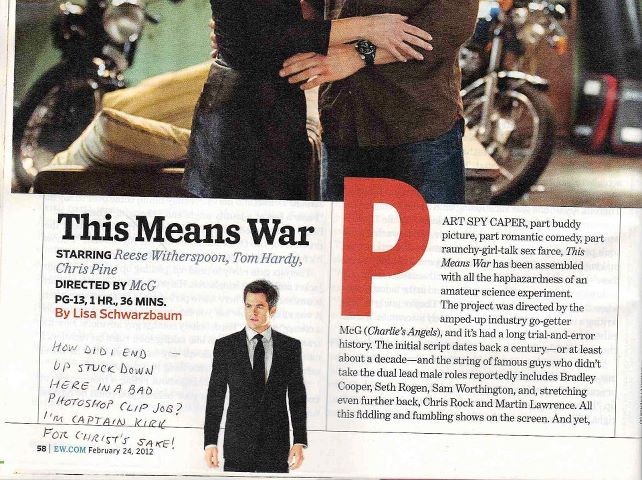
The Annotated Entertainment Weekly
We still get Entertainment Weekly because I hate their Web site. HATE it. It's ugly and badly organized. Would it kill them to consider tabs across the top so I don't have to slog through a bunch of reality television crap I don't give a shit about? Jesus. Seriously, I HATE EW.COM.
Okay, so rant over, here's the thing: I do enjoy EW's iPad interface. It's very nicely done. BUT . . . I can't annotate it.
See, our copy of Entertainment Weekly comes on Fridays, and it's a house rule that I get to read it first. Then it goes on the bathroom shelf for reading material. And sometimes I like to leave little notes for people to find . . .

It's sort of an Easter egg hunt.
Now when the EW people make it possible for me to add comments to the iPad version? We're golden.
Okay, so rant over, here's the thing: I do enjoy EW's iPad interface. It's very nicely done. BUT . . . I can't annotate it.
See, our copy of Entertainment Weekly comes on Fridays, and it's a house rule that I get to read it first. Then it goes on the bathroom shelf for reading material. And sometimes I like to leave little notes for people to find . . .
It's sort of an Easter egg hunt.
Now when the EW people make it possible for me to add comments to the iPad version? We're golden.
2.03.2012
Movie Review: The Decoy Bride
Starring: Kelly Macdonald, David Tennant, Alice Eve
Directed By: Sheree Folkson
Written By: Sally Phillips, Neil Jaworski
Isle of Man Film, 2012
NR; 89 minutes
4 stars (out of 5)
_______________________________________________________
A toe-curlingly cute, if rote, rom-com about hack writer James (Tennant) engaged to superstarlet Lara (Eve). In an attempt to mask their nuptials from the paparazzi, they select the remote Scottish island featured in James's only novel as the setting for their wedding. As an aside, I found this a rather silly plot device because it seems to me the tabloids would surely check that out as a possibility? But maybe those types of journalists aren't that smart.
Meanwhile, Katie has come back to the island of her girlhood and moved into the local bed-and-breakfast run by her mother. Soon she finds herself roped into standing in as the titular decoy bride when the press becomes alerted to James's and Lara's presence. And as expected, Katie falls for James, James falls for Katie, hilarity ensues.
To be fair, though, Decoy Bride is a sweet-natured movie that is exactly the right length—it doesn't tire the viewer with ongoing farce. There is just the right balance of pathos and humor, and while any number of secondary characters could have been more fleshed out, the fact that the film sticks with the story and doesn't much meander makes it immanently watchable.
Decoy Bride currently shows a release date of 9 March, though my guess is it will be limited in the US; last I looked there wasn't even a distributor for a US outing. Too bad, but some cable companies do have it On Demand. Would be perfect for Valentine's Day. If you're looking for something light and not too lengthy, this fits the bill.
Directed By: Sheree Folkson
Written By: Sally Phillips, Neil Jaworski
Isle of Man Film, 2012
NR; 89 minutes
4 stars (out of 5)
_______________________________________________________
A toe-curlingly cute, if rote, rom-com about hack writer James (Tennant) engaged to superstarlet Lara (Eve). In an attempt to mask their nuptials from the paparazzi, they select the remote Scottish island featured in James's only novel as the setting for their wedding. As an aside, I found this a rather silly plot device because it seems to me the tabloids would surely check that out as a possibility? But maybe those types of journalists aren't that smart.
Meanwhile, Katie has come back to the island of her girlhood and moved into the local bed-and-breakfast run by her mother. Soon she finds herself roped into standing in as the titular decoy bride when the press becomes alerted to James's and Lara's presence. And as expected, Katie falls for James, James falls for Katie, hilarity ensues.
To be fair, though, Decoy Bride is a sweet-natured movie that is exactly the right length—it doesn't tire the viewer with ongoing farce. There is just the right balance of pathos and humor, and while any number of secondary characters could have been more fleshed out, the fact that the film sticks with the story and doesn't much meander makes it immanently watchable.
Decoy Bride currently shows a release date of 9 March, though my guess is it will be limited in the US; last I looked there wasn't even a distributor for a US outing. Too bad, but some cable companies do have it On Demand. Would be perfect for Valentine's Day. If you're looking for something light and not too lengthy, this fits the bill.
1.25.2012
Books: The Spy Who Came In from the Cold and The Looking Glass War
I've been making my way through John le Carré's George Smiley novels. Not a whole lot of George Smiley in these past two; he's sort of a peripheral figure in them, a contact person for other, newer characters. I suppose it can be difficult to build too much around George himself, since he's so quiet and staid. He's a thinking man's hero, so if one is looking for action, one must turn to someone else. Which is what le Carré did in these two books.
They aren't bad. Cold is better than Looking, but they both go along about the same way. Each novel begins with a situation wherein the reader is immediately prompted to think, This can't end well. And it doesn't. After all, an inciting incident is required, particularly in spy fiction.
But, in fact, both novels continue with the this-can't-end-well feeling. A lot of work, a lot of risk, and the question of whether it will pay off—these are the shared themes between the two. The idea appears to be that there are no winners in the game of international espionage; it is a chess game that never ends because pieces removed from the board can always be replaced by new pawns.
And yet despite the lack of happy endings, the books are not unsatisfying. There are places where they become pedantic and long-winded, though I can also admire le Carré's detail. But even so, they are good, solid reads. Perfect for, say, a plane or train trip. And their chilly feel makes them right for fall and winter. (I don't know if you feel books have a season, but I certainly do.)
After the fact one is inclined to think the books could end no other way than as they do, and that is their one large fault: a sort of predestination is embedded in the lives of the characters le Carré creates. They seem to have no other options, no ability to make better choices. There is no moment when a reader might say, "If only," because what happens seems meant to happen; like a long, straight road across open country, there are no turns. Just a dead end. The characters seem to know it, and the reader does too, but the journey pulls them all along—the watched and the watchers—together to the end.
They aren't bad. Cold is better than Looking, but they both go along about the same way. Each novel begins with a situation wherein the reader is immediately prompted to think, This can't end well. And it doesn't. After all, an inciting incident is required, particularly in spy fiction.
But, in fact, both novels continue with the this-can't-end-well feeling. A lot of work, a lot of risk, and the question of whether it will pay off—these are the shared themes between the two. The idea appears to be that there are no winners in the game of international espionage; it is a chess game that never ends because pieces removed from the board can always be replaced by new pawns.
And yet despite the lack of happy endings, the books are not unsatisfying. There are places where they become pedantic and long-winded, though I can also admire le Carré's detail. But even so, they are good, solid reads. Perfect for, say, a plane or train trip. And their chilly feel makes them right for fall and winter. (I don't know if you feel books have a season, but I certainly do.)
After the fact one is inclined to think the books could end no other way than as they do, and that is their one large fault: a sort of predestination is embedded in the lives of the characters le Carré creates. They seem to have no other options, no ability to make better choices. There is no moment when a reader might say, "If only," because what happens seems meant to happen; like a long, straight road across open country, there are no turns. Just a dead end. The characters seem to know it, and the reader does too, but the journey pulls them all along—the watched and the watchers—together to the end.
1.12.2012
Book Review: The White Devil
Justin Evans
Harper, 2011
380 pages
hardbound
_____________________________________________________
I picked this one up when I saw it on the library's New Releases shelf for a couple reasons: (a) the cover looked interesting, (b) the title was vaguely familiar. Later I would remember that Entertainment Weekly had said it was really good. But I brought it home because the flap said it was a ghost story, and I do love a good ghost story.
In truth, The White Devil is part ghost story and part murder mystery. Seventeen-year-old Andrew Taylor has been shipped off from Connecticut to England to attend a boarding school. Which, of course, is haunted. Apparently Andrew's presence has roused the dormitory ghost, and . . . Well, I won't give too much away. But it has to do with Lord Byron, if that interests you at all.
Despite the fact that my synopsis makes it sound like a bad YA novel, The White Devil is a good read. The novel is populated with flawed adults as well as rowdy teenagers. And while the build is better than the finish, and some of the situations are predictable (the girlfriend is in danger!), as a whole the book is solid. The mystery does intrigue, as it is meant to, and the ghost is a real menace; some of the descriptions are not for the faint.
If it says anything to the quality of writing, I'm now considering looking up Evans' previous novel. He shows talent in The White Devil, and I'm curious as to whether it extends to his other work.
Harper, 2011
380 pages
hardbound
_____________________________________________________
I picked this one up when I saw it on the library's New Releases shelf for a couple reasons: (a) the cover looked interesting, (b) the title was vaguely familiar. Later I would remember that Entertainment Weekly had said it was really good. But I brought it home because the flap said it was a ghost story, and I do love a good ghost story.
In truth, The White Devil is part ghost story and part murder mystery. Seventeen-year-old Andrew Taylor has been shipped off from Connecticut to England to attend a boarding school. Which, of course, is haunted. Apparently Andrew's presence has roused the dormitory ghost, and . . . Well, I won't give too much away. But it has to do with Lord Byron, if that interests you at all.
Despite the fact that my synopsis makes it sound like a bad YA novel, The White Devil is a good read. The novel is populated with flawed adults as well as rowdy teenagers. And while the build is better than the finish, and some of the situations are predictable (the girlfriend is in danger!), as a whole the book is solid. The mystery does intrigue, as it is meant to, and the ghost is a real menace; some of the descriptions are not for the faint.
If it says anything to the quality of writing, I'm now considering looking up Evans' previous novel. He shows talent in The White Devil, and I'm curious as to whether it extends to his other work.
12.16.2011
Movie Review: Sherlock Holmes: A Game of Shadows
Starring: Robert Downey Jr., Jude Law, Jared Harris, Noomi Rapace, Stephen Fry
Directed By: Guy Ritchie
Written By: Michele Mulroney, Kieran Mulroney (screenplay), from the characters created by Arthur Conan Doyle
Warner Bros., 2011
PG-13; 129 minutes
3 stars (out of 5)
_______________________________________________________
Sherlock Holmes: A Game of Shadows is a fun movie. Entertaining. Which is what it's supposed to be. But it's not a great movie. I found my mind wandering at moments. And when you're talking Sherlock Holmes--a man whose mind moves so quickly that one should have to pay attention to keep up--well, it's kind of a shame that it didn't engage me more or require more effort.
The movie brings us back to Jude Law playing Watson to Downey's Holmes. (View my review of the first film for a refresher.) Watson has removed himself from Baker Street in advance of his coming marriage. Meanwhile, Holmes has become obsessed with the nefarious dealings of Professor James Moriarty (Jared Harris). When Moriarty threatens Watson and his new bride, Holmes has no choice but to hijack their honeymoon. Mrs. Watson is shipped off to Holmes' brother Mycroft (Fry) for safe keeping while Holmes and Watson trek from Paris to Germany to Switzerland, putting together the pieces of their adversary's great puzzle. There is no question how it will end--anyone who knows anything about Sherlock Holmes knows Switzerland means only one thing, and Mycroft mentions Reichenbach early in the movie--but the getting there is half the fun, right?
Well, yes and no. A lot of the film is a game of dress up more than shadows; Downey sports innumerable disguises throughout. Meanwhile, what passes for intrigue is thin indeed, hence my ability to check out a couple times without really having missed much. Rapace as a Gypsy in search of her missing brother is an excuse for the plot, leaving her to act as so much wallpaper during much of the movie. Still, there is humor, and while some of the visual effects are gimmicky (the fight between Holmes and the Cossack can barely be followed due to cuts, dark lighting, and sped up film), the scene in which they run through the forest is optically interesting, making a scene that would otherwise be too long seem just right.
SH:AGOS attempts a nod at the bromance aspect of Holmes' and Watson's relationship (sharing tight quarters! and they dance together!) but it falls short of homoerotic, probably due to not wanting to risk the male audience's discomfort. Here Holmes and Watson are more like frat brothers than anything romantic.
To summarize: the dialogue is clunky in places and the plot is thin, but SH:AGOS still manages to please on a few levels. The chemistry between Downey and Law is distinct and almost tangible, entertaining enough in its own right. Paul Anderson did an especially fine job as sharpshooter Colonel Sebastian Moran. And watching Holmes and Moriarty play chess--both literally and mentally--is compelling at times as well, making one wish they'd interacted a bit more. Also, if they'd played Holmes as a bit more manic, more obsessed with Moriarty, almost to the point that one would have to wonder if he wasn't just losing it . . . That would have added some dimension and made the whole of the story that much more involving. Alas, the down side of having a well-known character with an equally well-known nemesis is that you can't really pull something like that off very easily; everyone knows Moriarty is evil. Right? (Maybe with the next one they can have Holmes insisting Moriarty is alive, but nobody believes him?)
The first film had a stronger plot and was better written. That one also had a sort of "play along" feel that allowed the audience to gather the clues along with Holmes, something SH:AGOS sort of cheats on. But this one is still fun, a solid enough entry in what is looking to become another big franchise for Downey & co.
Directed By: Guy Ritchie
Written By: Michele Mulroney, Kieran Mulroney (screenplay), from the characters created by Arthur Conan Doyle
Warner Bros., 2011
PG-13; 129 minutes
3 stars (out of 5)
_______________________________________________________
Sherlock Holmes: A Game of Shadows is a fun movie. Entertaining. Which is what it's supposed to be. But it's not a great movie. I found my mind wandering at moments. And when you're talking Sherlock Holmes--a man whose mind moves so quickly that one should have to pay attention to keep up--well, it's kind of a shame that it didn't engage me more or require more effort.
The movie brings us back to Jude Law playing Watson to Downey's Holmes. (View my review of the first film for a refresher.) Watson has removed himself from Baker Street in advance of his coming marriage. Meanwhile, Holmes has become obsessed with the nefarious dealings of Professor James Moriarty (Jared Harris). When Moriarty threatens Watson and his new bride, Holmes has no choice but to hijack their honeymoon. Mrs. Watson is shipped off to Holmes' brother Mycroft (Fry) for safe keeping while Holmes and Watson trek from Paris to Germany to Switzerland, putting together the pieces of their adversary's great puzzle. There is no question how it will end--anyone who knows anything about Sherlock Holmes knows Switzerland means only one thing, and Mycroft mentions Reichenbach early in the movie--but the getting there is half the fun, right?
Well, yes and no. A lot of the film is a game of dress up more than shadows; Downey sports innumerable disguises throughout. Meanwhile, what passes for intrigue is thin indeed, hence my ability to check out a couple times without really having missed much. Rapace as a Gypsy in search of her missing brother is an excuse for the plot, leaving her to act as so much wallpaper during much of the movie. Still, there is humor, and while some of the visual effects are gimmicky (the fight between Holmes and the Cossack can barely be followed due to cuts, dark lighting, and sped up film), the scene in which they run through the forest is optically interesting, making a scene that would otherwise be too long seem just right.
SH:AGOS attempts a nod at the bromance aspect of Holmes' and Watson's relationship (sharing tight quarters! and they dance together!) but it falls short of homoerotic, probably due to not wanting to risk the male audience's discomfort. Here Holmes and Watson are more like frat brothers than anything romantic.
To summarize: the dialogue is clunky in places and the plot is thin, but SH:AGOS still manages to please on a few levels. The chemistry between Downey and Law is distinct and almost tangible, entertaining enough in its own right. Paul Anderson did an especially fine job as sharpshooter Colonel Sebastian Moran. And watching Holmes and Moriarty play chess--both literally and mentally--is compelling at times as well, making one wish they'd interacted a bit more. Also, if they'd played Holmes as a bit more manic, more obsessed with Moriarty, almost to the point that one would have to wonder if he wasn't just losing it . . . That would have added some dimension and made the whole of the story that much more involving. Alas, the down side of having a well-known character with an equally well-known nemesis is that you can't really pull something like that off very easily; everyone knows Moriarty is evil. Right? (Maybe with the next one they can have Holmes insisting Moriarty is alive, but nobody believes him?)
The first film had a stronger plot and was better written. That one also had a sort of "play along" feel that allowed the audience to gather the clues along with Holmes, something SH:AGOS sort of cheats on. But this one is still fun, a solid enough entry in what is looking to become another big franchise for Downey & co.
12.12.2011
Movie Review: Midnight in Paris
Starring: Owen Wilson, Rachel McAdams, Marion Cotillard
Directed By: Woody Allen
Written By: Woody Allen
Gravier Productions, 2011
PG-13; 94 minutes
4 stars (out of 5)
_______________________________________________________
IMDB has this movie listed as a comedy, which surprised me because I didn't see a whole lot of funny in it. But then again, comedy has a lot of different flavors, and Woody Allen isn't known for belly laughs. His comedy tends toward the more thought-inducing and neurotic.
I'll start out by admitting I'm no huge fan of Woody Allen; I haven't seen more than a handful of his movies. We had to watch Annie Hall in film school, of course, and while I thought that was an okay film, I had a difficult time understanding all the hype around it. Maybe I was born in the wrong era, or maybe I just don't think that way.
But I really liked Midnight in Paris. This is probably because I'm a writer in love with a foreign city myself and so I could completely identify with Wilson's character. He plays Gil, an established screenwriter who is taking a sabbatical of sorts in Paris so he can write what he hopes will be a great literary novel. Tagging along are his fiancée Inez and her parents, as well as some other friends of hers . . . Gil evidently has inherited all friends and family and has none of his own.
If I have one bone to pick with Midnight in Paris, it's that I cannot for the life of me figure out why Gil and Inez are together. They have nothing in common, and she has a terrible habit of making fun of him by relating sensitive and embarrassing anecdotes to others. Gil is a nice-guy liberal; Inez and her family are stuck-up right-wingers. If I had to guess, I'd say Inez was originally drawn by Gil's prospects, his connections as a screenwriter, which is likely why she fights him so hard when Gil mentions (repeatedly) that he might prefer to settle in the City of Lights indefinitely.
This is all prologue, of course; the real story here is how every night at midnight, Gil gets magically swept into the 1920s Parisian scene. While there he meets Ernest Hemingway, Pablo Picasso, Dali, the Fitzgeralds, Cole Porter, and Gertrude Stein (portrayed quite well by Kathy Bates) among others. Meeting these icons gives Gil a shot of literary mojo. In fact, it seems almost addictive for him; Gil begins retreating from the modern world more and more as he begins to dwell on and within this fantastical space.
Of course, the underlying theme in Midnight in Paris is about the grass being greener. When Gil and a 1920s artists' model named Adriana (Cotillard) get swept back into the 1890s, she proclaims that she never wants to return to the present--her present, the 1920s. After all, the "now" is boring; things were so much better in the good ol' days. As Gil tries to convince her otherwise, he comes to the realization that escapism is no answer to life's problems.
It's a delicate balance; as a writer I know the value of living within one's imagination, sometimes for long periods of time. Breaking the dreamy concentration can be costly to a story or script. Interruption is generally unwelcome. But one also has to surface now and again, participate in real life, and be present in the present, else life can come crashing down while you're living and breathing an otherwhere.
Midnight in Paris is a gentle film, and beautiful in a cinematographic way, even if it carries no heavy insights into life. The motion in the film, both outward and introspectively, is slow, like a dawning. This is not a movie designed to jolt, or even to prompt great discussion; instead it is a love letter to the creative mind, and to all the influences that crowd it.
Directed By: Woody Allen
Written By: Woody Allen
Gravier Productions, 2011
PG-13; 94 minutes
4 stars (out of 5)
_______________________________________________________
IMDB has this movie listed as a comedy, which surprised me because I didn't see a whole lot of funny in it. But then again, comedy has a lot of different flavors, and Woody Allen isn't known for belly laughs. His comedy tends toward the more thought-inducing and neurotic.
I'll start out by admitting I'm no huge fan of Woody Allen; I haven't seen more than a handful of his movies. We had to watch Annie Hall in film school, of course, and while I thought that was an okay film, I had a difficult time understanding all the hype around it. Maybe I was born in the wrong era, or maybe I just don't think that way.
But I really liked Midnight in Paris. This is probably because I'm a writer in love with a foreign city myself and so I could completely identify with Wilson's character. He plays Gil, an established screenwriter who is taking a sabbatical of sorts in Paris so he can write what he hopes will be a great literary novel. Tagging along are his fiancée Inez and her parents, as well as some other friends of hers . . . Gil evidently has inherited all friends and family and has none of his own.
If I have one bone to pick with Midnight in Paris, it's that I cannot for the life of me figure out why Gil and Inez are together. They have nothing in common, and she has a terrible habit of making fun of him by relating sensitive and embarrassing anecdotes to others. Gil is a nice-guy liberal; Inez and her family are stuck-up right-wingers. If I had to guess, I'd say Inez was originally drawn by Gil's prospects, his connections as a screenwriter, which is likely why she fights him so hard when Gil mentions (repeatedly) that he might prefer to settle in the City of Lights indefinitely.
This is all prologue, of course; the real story here is how every night at midnight, Gil gets magically swept into the 1920s Parisian scene. While there he meets Ernest Hemingway, Pablo Picasso, Dali, the Fitzgeralds, Cole Porter, and Gertrude Stein (portrayed quite well by Kathy Bates) among others. Meeting these icons gives Gil a shot of literary mojo. In fact, it seems almost addictive for him; Gil begins retreating from the modern world more and more as he begins to dwell on and within this fantastical space.
Of course, the underlying theme in Midnight in Paris is about the grass being greener. When Gil and a 1920s artists' model named Adriana (Cotillard) get swept back into the 1890s, she proclaims that she never wants to return to the present--her present, the 1920s. After all, the "now" is boring; things were so much better in the good ol' days. As Gil tries to convince her otherwise, he comes to the realization that escapism is no answer to life's problems.
It's a delicate balance; as a writer I know the value of living within one's imagination, sometimes for long periods of time. Breaking the dreamy concentration can be costly to a story or script. Interruption is generally unwelcome. But one also has to surface now and again, participate in real life, and be present in the present, else life can come crashing down while you're living and breathing an otherwhere.
Midnight in Paris is a gentle film, and beautiful in a cinematographic way, even if it carries no heavy insights into life. The motion in the film, both outward and introspectively, is slow, like a dawning. This is not a movie designed to jolt, or even to prompt great discussion; instead it is a love letter to the creative mind, and to all the influences that crowd it.
12.10.2011
Movie Review: Tinker, Tailor, Soldier, Spy
Starring: Gary Oldman, Colin Firth, A Bunch of Other British Dudes
Directed By: Tomas Alfredson
Written By: John Le Carré (novel), Bridget O'Connor & Peter Straughan (screenplay)
Focus Features/Studio Canal, 2011
R; 127 minutes
4 stars (out of 5)
_______________________________________________________
I recently read and reviewed the book this movie was based on, and I have to say it did help that I was already familiar with the source material because the movie has the potential to be confusing to those who don't already know the story. And yet the writers made enough alterations from the novel that, having just read it, I was very aware of what was different and missing, too. It was a little like one of those picture games where you have two images and are told to find all the changes.
As a film, Tinker, Tailor, Soldier, Spy is a Cold War-era tale of British espionage in which Oldman plays "retired" (read: booted) MI6 agent George Smiley, who is pulled back into the world of "The Circus" in order to help smoke out a mole working for the Russians. That sounds like a simple enough story, but these are spies, remember, so everything becomes very convoluted very quickly. And while the film is good—better than good, actually—it suffers a little in comparison to the book, not because of the changes that have been made (the changes work very well), but because the characters don't get enough of an introduction for the viewers to necessarily follow them easily or get any real sense of them at all. If I hadn't only just read the novel, I would almost certainly have been asking myself, Which one is that guy again? and Wait, what was his story? Maybe even, Why should I care about him, exactly?
TTSS requires undivided attention. There are a lot of people and a lot of cuts between past and present. Still, the story is good enough to hold an audience's interest, which makes it somewhat better than the book in that respect, since parts of the novel were prone to drag. As Smiley, Oldman is able to pull all focus to him; his smallest motions convey as much as any length of dialogue might. Flashbacks to what must have been the worst Christmas party in history add a strange weight, a sorrow, to the whole of the film.
Along with Oldman, Mark Strong, whom I usually think of as a villain, has a small, non-evil role, and the quiet strength of his performance is lovely. Tom Hardy, too, shines a bit as a rogue agent whose emotions get the better of him, even as he tries to do the right thing.
It's a nice-looking film, too, the bad 70s haircuts notwithstanding. A sort of sodium filter gives everything the tint of an old photograph, which lends itself to the story quite well.
Still and all, it isn't edge-of-your-seat spy thriller entertainment. Nothing is exploding. There are one or two tense scenes in which someone is in jeopardy—and maybe I would have felt it more if I hadn't already known the outcomes—but the overall feel is one of quiet reflection and semi-nostalgia. Which sounds boring, but somehow TTSS (and Oldman) pulls it off.
And at the end of the day, as the credits roll, one could easily imagine another George Smiley movie to follow. Even hope for one. Just give me enough warning so I can read the novel first, please.
Directed By: Tomas Alfredson
Written By: John Le Carré (novel), Bridget O'Connor & Peter Straughan (screenplay)
Focus Features/Studio Canal, 2011
R; 127 minutes
4 stars (out of 5)
_______________________________________________________
I recently read and reviewed the book this movie was based on, and I have to say it did help that I was already familiar with the source material because the movie has the potential to be confusing to those who don't already know the story. And yet the writers made enough alterations from the novel that, having just read it, I was very aware of what was different and missing, too. It was a little like one of those picture games where you have two images and are told to find all the changes.
As a film, Tinker, Tailor, Soldier, Spy is a Cold War-era tale of British espionage in which Oldman plays "retired" (read: booted) MI6 agent George Smiley, who is pulled back into the world of "The Circus" in order to help smoke out a mole working for the Russians. That sounds like a simple enough story, but these are spies, remember, so everything becomes very convoluted very quickly. And while the film is good—better than good, actually—it suffers a little in comparison to the book, not because of the changes that have been made (the changes work very well), but because the characters don't get enough of an introduction for the viewers to necessarily follow them easily or get any real sense of them at all. If I hadn't only just read the novel, I would almost certainly have been asking myself, Which one is that guy again? and Wait, what was his story? Maybe even, Why should I care about him, exactly?
TTSS requires undivided attention. There are a lot of people and a lot of cuts between past and present. Still, the story is good enough to hold an audience's interest, which makes it somewhat better than the book in that respect, since parts of the novel were prone to drag. As Smiley, Oldman is able to pull all focus to him; his smallest motions convey as much as any length of dialogue might. Flashbacks to what must have been the worst Christmas party in history add a strange weight, a sorrow, to the whole of the film.
Along with Oldman, Mark Strong, whom I usually think of as a villain, has a small, non-evil role, and the quiet strength of his performance is lovely. Tom Hardy, too, shines a bit as a rogue agent whose emotions get the better of him, even as he tries to do the right thing.
It's a nice-looking film, too, the bad 70s haircuts notwithstanding. A sort of sodium filter gives everything the tint of an old photograph, which lends itself to the story quite well.
Still and all, it isn't edge-of-your-seat spy thriller entertainment. Nothing is exploding. There are one or two tense scenes in which someone is in jeopardy—and maybe I would have felt it more if I hadn't already known the outcomes—but the overall feel is one of quiet reflection and semi-nostalgia. Which sounds boring, but somehow TTSS (and Oldman) pulls it off.
And at the end of the day, as the credits roll, one could easily imagine another George Smiley movie to follow. Even hope for one. Just give me enough warning so I can read the novel first, please.
12.07.2011
Two Questions
If I could ask Benedict Cumberbatch two questions:
1. Would you name your son Timothy?
2. What did you do for Speech Day?
1. Would you name your son Timothy?
2. What did you do for Speech Day?
11.22.2011
Book Review: Thomas and Friends On Track with Phonics: Fox in the Box
This is a little book that came in a set of 12 I bought for my 2-year-old at the book fair at his school last week. He loves Thomas the Tank Engine, and the minute he saw these books he had to have them. They were produced by Random House, copyrighted 2010.
Tonight I read him the book titled Fox in the Box, and I have to say: it is a terrible book. I understand the need to use certain words and sounds when teaching phonics, but they could have done better than this.
The story begins with Thomas and Percy (another train engine, for those not versed in Thomas lore) wanting to have a party. There's no clear reason for this celebration; they're just party animals, those two. Lucky for them they have a box filled with nuts, bags, and caps. Woo-hoo! Bring it!
Things go awry, however, when a fox comes along and gets into the box. This fox eats the nuts and "nips and rips" the bags, which sends tattle-tale Thomas running to Driver Dan to beg him to do something. But before Dan can come up with a plan, it starts to rain.
Turns out the fox doesn't like rain. So he runs off to another box—this one empty—seeking refuge. It's not entirely clear why the fox didn't just stay in the first box, which appeared to be inside and sheltered from the rain. But we'll let that pass and focus on the truly dreadful outcome of this story.
The fox is in the empty box, hiding from the rain. Driver Dan then comes along and puts a lid on the box so that only the fox's tail is hanging out. Meanwhile, Thomas and Percy get to throw their wild party, nuts, bags, caps and all. And the final page? It reads: "The party was fun. But not for the fox."
Sure enough, with confetti flying, there are Thomas and Percy having a party and the box with the fox's tail sitting in the middle of it all. Instead of letting this poor fox go free somewhere, Driver Dan and the tank engines have apparently decided to subject it to captivity and mockery. (They also haven't invited any of the other trains from what I can tell.) It's not a terribly edifying lesson, is almost baffling in its bizarre "twist ending."
I haven't read any of the other books in this collection, though my husband assures me Go, Bertie, Go features Dan wielding a bat for no apparent reason. I'm starting to think Dan needs a holiday or therapy or something. I fear he's encouraging anti-social behavior in the sheds.
Tonight I read him the book titled Fox in the Box, and I have to say: it is a terrible book. I understand the need to use certain words and sounds when teaching phonics, but they could have done better than this.
The story begins with Thomas and Percy (another train engine, for those not versed in Thomas lore) wanting to have a party. There's no clear reason for this celebration; they're just party animals, those two. Lucky for them they have a box filled with nuts, bags, and caps. Woo-hoo! Bring it!
Things go awry, however, when a fox comes along and gets into the box. This fox eats the nuts and "nips and rips" the bags, which sends tattle-tale Thomas running to Driver Dan to beg him to do something. But before Dan can come up with a plan, it starts to rain.
Turns out the fox doesn't like rain. So he runs off to another box—this one empty—seeking refuge. It's not entirely clear why the fox didn't just stay in the first box, which appeared to be inside and sheltered from the rain. But we'll let that pass and focus on the truly dreadful outcome of this story.
The fox is in the empty box, hiding from the rain. Driver Dan then comes along and puts a lid on the box so that only the fox's tail is hanging out. Meanwhile, Thomas and Percy get to throw their wild party, nuts, bags, caps and all. And the final page? It reads: "The party was fun. But not for the fox."
Sure enough, with confetti flying, there are Thomas and Percy having a party and the box with the fox's tail sitting in the middle of it all. Instead of letting this poor fox go free somewhere, Driver Dan and the tank engines have apparently decided to subject it to captivity and mockery. (They also haven't invited any of the other trains from what I can tell.) It's not a terribly edifying lesson, is almost baffling in its bizarre "twist ending."
I haven't read any of the other books in this collection, though my husband assures me Go, Bertie, Go features Dan wielding a bat for no apparent reason. I'm starting to think Dan needs a holiday or therapy or something. I fear he's encouraging anti-social behavior in the sheds.
11.04.2011
Book Review: Tinker, Tailor, Soldier, Spy
John Le Carré
Alfred A. Knopf, 1974
355 pages
hardcover
_____________________________________________________
This book was kind of excruciating to read, but I dogged my way through it because I wanted to know the story before the film opens in the U.S. in December. I'd never read anything by Le Carré before, so I don't know if all his books are as much of a slog as this one. Or maybe it's just that I'm out of practice with the whole spy thriller genre; I go through cycles with what I read and haven't done Clancy and his ilk in at least a decade or more.
While reading TTSS, I could absolutely picture how I would script it for film, but it works better that way than in prose, I think. A lot of the story involves the main character—a British spy named George Smiley who has been forced into retirement—reading old dossiers and interviewing witnesses. Not terribly engaging in and of itself, but easy to fix with visuals within a movie.
There are a handful of honestly intense moments, but they are outweighed by the long intervals of reminiscences. I think some of the flashbacks are intended to be intense, too, but since the reader already knows who came out alive, there's little to sustain the tension.
The core of the story is Smiley attempting to ferret out a double agent, or "mole," but finding out who, or even why (and admittedly the "why" is flimsy in any case), ends up being not so interesting as how.
I know TTSS was not Le Carré's first novel, and knowing so little about his catalogue of work, I have no idea if I was supposed to know Smiley and some of the other characters from previous tales. If so, this may have been one of the reasons I found the book a bit thin on character development. All these potentially interesting people, but it was more tell than show when it came to interior dialogue and motives. I wanted to see them do things that would inform me about their characters, but it was a lot of sitting and talking, or sitting and reading, or walking and talking, or riding in cars and talking (which is more or less the same as sitting and talking), or the author simply telling the reader what the character felt. In the end, all this gave the feeling that the characters lacked depth.
Or maybe that's the point. Maybe spies lack depth because they're all façade in any case. But really, that makes the meal somewhat unsatisfying. Considering the time I'm devoting to the story, I'd like to think all the people I'm reading about have complex makeups, even when showing only one facet—the reader should be led to believe it's one facet of many. In TTSS, whether it be the British rectitude or secret agent reserve, the reader may not be convinced there's any more to the men than the little that is shown.
Alfred A. Knopf, 1974
355 pages
hardcover
_____________________________________________________
This book was kind of excruciating to read, but I dogged my way through it because I wanted to know the story before the film opens in the U.S. in December. I'd never read anything by Le Carré before, so I don't know if all his books are as much of a slog as this one. Or maybe it's just that I'm out of practice with the whole spy thriller genre; I go through cycles with what I read and haven't done Clancy and his ilk in at least a decade or more.
While reading TTSS, I could absolutely picture how I would script it for film, but it works better that way than in prose, I think. A lot of the story involves the main character—a British spy named George Smiley who has been forced into retirement—reading old dossiers and interviewing witnesses. Not terribly engaging in and of itself, but easy to fix with visuals within a movie.
There are a handful of honestly intense moments, but they are outweighed by the long intervals of reminiscences. I think some of the flashbacks are intended to be intense, too, but since the reader already knows who came out alive, there's little to sustain the tension.
The core of the story is Smiley attempting to ferret out a double agent, or "mole," but finding out who, or even why (and admittedly the "why" is flimsy in any case), ends up being not so interesting as how.
I know TTSS was not Le Carré's first novel, and knowing so little about his catalogue of work, I have no idea if I was supposed to know Smiley and some of the other characters from previous tales. If so, this may have been one of the reasons I found the book a bit thin on character development. All these potentially interesting people, but it was more tell than show when it came to interior dialogue and motives. I wanted to see them do things that would inform me about their characters, but it was a lot of sitting and talking, or sitting and reading, or walking and talking, or riding in cars and talking (which is more or less the same as sitting and talking), or the author simply telling the reader what the character felt. In the end, all this gave the feeling that the characters lacked depth.
Or maybe that's the point. Maybe spies lack depth because they're all façade in any case. But really, that makes the meal somewhat unsatisfying. Considering the time I'm devoting to the story, I'd like to think all the people I'm reading about have complex makeups, even when showing only one facet—the reader should be led to believe it's one facet of many. In TTSS, whether it be the British rectitude or secret agent reserve, the reader may not be convinced there's any more to the men than the little that is shown.
10.15.2011
Movie Review: Thor
Starring: Chris Hemsworth, Natalie Portman, Anthony Hopkins
Directed By: Kenneth Branagh
Written By: Ashley Miller, Zack Stentz, Don Payne (screenplay); J Michael Straczynski, Mark Protosevich (story); Stan Lee, Larry Lieber, Jack Kirby (comic book)
Paramount Pictures/Marvel Entertainment, 2011
PG-13; 115 minutes
2 stars (out of 5)
_______________________________________________________
This is how I envision Thor having been written: J Michael Straczynski (creator of Babylon 5) sketched out the story on a napkin while spending a good deal of time at a bar, probably celebrating however much they paid him to do the job. All well and good until he set his drink on the napkin. Then some of what he wrote got a little blurry. And by the time Protosevich got hold of it, he could only read about half. He made some additional notes—that may or may not have had anything to do with anything JMS had written—then faxed the napkin to the screenwriters, but of course it got shredded by the fax machine. This left the screenwriters with no choice but to try to piece together what they could of what had probably been something decent if not brilliant but was now the screenplay equivalent of mincemeat. They threw in some filler for the parts they couldn't find or decipher. The end result: the mess that is Thor.
Truthfully, it's a textbook movie. It's so predictable one thinks it must have been written by film students who only just learned about plot and three-act structure. And it's streamlined all to hell—most character development has been cut in favor of action sequences. If we're supposed to believe there's some kind of chemistry between Jane Foster (Portman) and Thor (Hemsworth), well . . . Let's just say even my rather extensive ability to suspend my disbelief doesn't stretch quite so far.
As my husband put it, a lot of the movie is about a woman who doesn't drive very well. And I just had that "Rainbow Road" video from YouTube stuck in my head the entire time.
It probably didn't help that our cat's name is Loki. He would have made a much better villain, I think; especially if we got him that horned helmet and a cape.
All the scenes in Asgard look like cut scenes from a Final Fantasy game. And everything there is very shiny. Are Norse gods also magpies or something? They seem to really, really like shiny things is all I'm saying.
It wouldn't have hurt if Thor had had a tad more humor, either. I wanted a reason to laugh, even just once or twice, but most of the dialogue falls flat. That is to say, the stuff that maybe is supposed to be funny isn't, and none of it is unintentionally funny either, so the movie ends up feeling monotonous in overall tone.
As a whole, the feeling is they made Thor simply because they felt they had to in order to introduce the character in advance of The Avengers. If you do bother to watch, wait for the scene after the end credits; it was reportedly done by Joss Whedon (uncredited) and is in the style the rest of the movie should have been. Not that I don't love Branagh, and I'm sure he did the best he could with what he had for material, but . . . Seriously. Does Asgard really need to be that shiny?
Directed By: Kenneth Branagh
Written By: Ashley Miller, Zack Stentz, Don Payne (screenplay); J Michael Straczynski, Mark Protosevich (story); Stan Lee, Larry Lieber, Jack Kirby (comic book)
Paramount Pictures/Marvel Entertainment, 2011
PG-13; 115 minutes
2 stars (out of 5)
_______________________________________________________
This is how I envision Thor having been written: J Michael Straczynski (creator of Babylon 5) sketched out the story on a napkin while spending a good deal of time at a bar, probably celebrating however much they paid him to do the job. All well and good until he set his drink on the napkin. Then some of what he wrote got a little blurry. And by the time Protosevich got hold of it, he could only read about half. He made some additional notes—that may or may not have had anything to do with anything JMS had written—then faxed the napkin to the screenwriters, but of course it got shredded by the fax machine. This left the screenwriters with no choice but to try to piece together what they could of what had probably been something decent if not brilliant but was now the screenplay equivalent of mincemeat. They threw in some filler for the parts they couldn't find or decipher. The end result: the mess that is Thor.
Truthfully, it's a textbook movie. It's so predictable one thinks it must have been written by film students who only just learned about plot and three-act structure. And it's streamlined all to hell—most character development has been cut in favor of action sequences. If we're supposed to believe there's some kind of chemistry between Jane Foster (Portman) and Thor (Hemsworth), well . . . Let's just say even my rather extensive ability to suspend my disbelief doesn't stretch quite so far.
As my husband put it, a lot of the movie is about a woman who doesn't drive very well. And I just had that "Rainbow Road" video from YouTube stuck in my head the entire time.
It probably didn't help that our cat's name is Loki. He would have made a much better villain, I think; especially if we got him that horned helmet and a cape.
All the scenes in Asgard look like cut scenes from a Final Fantasy game. And everything there is very shiny. Are Norse gods also magpies or something? They seem to really, really like shiny things is all I'm saying.
It wouldn't have hurt if Thor had had a tad more humor, either. I wanted a reason to laugh, even just once or twice, but most of the dialogue falls flat. That is to say, the stuff that maybe is supposed to be funny isn't, and none of it is unintentionally funny either, so the movie ends up feeling monotonous in overall tone.
As a whole, the feeling is they made Thor simply because they felt they had to in order to introduce the character in advance of The Avengers. If you do bother to watch, wait for the scene after the end credits; it was reportedly done by Joss Whedon (uncredited) and is in the style the rest of the movie should have been. Not that I don't love Branagh, and I'm sure he did the best he could with what he had for material, but . . . Seriously. Does Asgard really need to be that shiny?
10.11.2011
Book Review: Becoming Jane Austen
Jon Spence
Continuum, 2007
312 pages
trade paperback
_____________________________________________________
This is the book the film Becoming Jane was based on. Now to be fair, my husband and I had tried to watch Becoming Jane a couple years back and couldn't get into it, so we turned it off after 15 minutes. Maybe we were just in the wrong frame of mind, or maybe this is the kind of story that doesn't translate so smoothly. Dunno.
I picked up the book because at some point it occurred to me that although I like Austen's writing (and yet I haven't read all of her work, though I probably should), I knew very little about her as a person. So I got curious. And then I went to the library, and this was one of the most recent books they had on the biography shelf. I figured recent information was probably better than, say, books from the 60s and 70s, so . . .
Becoming Jane Austen is good. It's well written, thorough, but not dry. Very accessible. It's almost a shame there's not more concrete information about Austen's life, but Spence does very well with what's available.
And I have to say I find it a fun fact that Jane and I were born almost exactly 200 years apart, plus one day . . . I guess I'd better hope I don't die at age 41, though.
Bottom line is I now know more about Jane Austen than I did, which was the goal. And had a nice time learning, thanks to this book.
Continuum, 2007
312 pages
trade paperback
_____________________________________________________
This is the book the film Becoming Jane was based on. Now to be fair, my husband and I had tried to watch Becoming Jane a couple years back and couldn't get into it, so we turned it off after 15 minutes. Maybe we were just in the wrong frame of mind, or maybe this is the kind of story that doesn't translate so smoothly. Dunno.
I picked up the book because at some point it occurred to me that although I like Austen's writing (and yet I haven't read all of her work, though I probably should), I knew very little about her as a person. So I got curious. And then I went to the library, and this was one of the most recent books they had on the biography shelf. I figured recent information was probably better than, say, books from the 60s and 70s, so . . .
Becoming Jane Austen is good. It's well written, thorough, but not dry. Very accessible. It's almost a shame there's not more concrete information about Austen's life, but Spence does very well with what's available.
And I have to say I find it a fun fact that Jane and I were born almost exactly 200 years apart, plus one day . . . I guess I'd better hope I don't die at age 41, though.
Bottom line is I now know more about Jane Austen than I did, which was the goal. And had a nice time learning, thanks to this book.
10.03.2011
Television: Doctor Who finale
All right, let's start from the tippy top. My dad used to watch Doctor Who when I was a kid, and I'd sometimes sit with him (we only had the one television), but I never did follow what was going on exactly, and it all looked a bit silly to me. Still and all, when the program was rebooted in 2005, my husband and I tried it out. We didn't get more than a couple episodes in, however. Maybe it was that we had other demands on our time—our first son was born that November—and/or that, in the list of shows we had time to fit in, Doctor Who fell toward the end.
NOW, a few years later, with kids a little older and us having a bit more free time to ourselves (and our almost 6-year-old finding DW to be a treat), and also the advent of streaming video, we've had the chance to catch up. And as a rule I do enjoy Doctor Who. I could debate the pros and cons of Tennant versus Smith all day, I could delve into the darker side of the Doctor and his psyche, what-have-you. But I really want to focus on the two Smith finales, by which I mean that of the last series (what we in the States would call "last season") and this past one as well. Because they seemed remarkably similar in tone and execution, which makes me worry that Steven Moffat might be dipping too often from the same well.
Here's the thing: last year the finale was "The Big Bang," in which the Doctor was in the Pandorica, but then he wasn't, and then he was going to die in 12 minutes, but then he didn't, and they had to recreate the Big Bang so the world could go back to normal. This year's finale was "The Wedding of River Song," in which the Doctor was once again going to die on a certain day and time, but then he didn't, and that messed things up in the world, so he had to fake his death so time could go back to normal.
Point 1. In each case, at least part if not most of the tension was predicated on the anticipation of the coming death of the Doctor. If this is your go-to crisis for every series finale, something is wrong. How many times can he die, or almost die, but not really die, or else come back from the dead, before the audience ceases to care? The only time this works is (a) if the program is in real danger of cancelation and the audience isn't sure if it's ending, and/or (b) there's a real chance the actor is leaving and the audience wants to see if there's a new Doctor.
Point 2. In both these finales, the pseudo-science causing the problem was, er . . . Jumbled? Not compelling? The core plots seemed flimsy. They were excuses for the characters to have long-winded conversations about their emotions. If you pay attention, that's how Doctor Who functions: the science is rattled off at light speed while the soapy interactions are prolonged. I don't have a problem with this as a rule; I'm the kind of person who enjoys character development. And if any of these characters were actually developing, I'd be ecstatic. But they all appear to be a bit stuck in their ways, forms and functions these days. River Song will always save the day and Rory will always be the underdog, while Amy usually has to step in and help him. If Rory does happen to rescue someone or something, it's generally by accident, a happy byproduct of his own clumsy existence. For once I'd like to see River Song not so sure of herself. I'd like to see Rory put his foot down in a way that the others can't railroad him. It's not in his established character makeup for him to walk away, but what if he finally did? That would be interesting. Not only because it'd be new for the character, but because the situation that would cause such a fundamentally changed reaction in him would have to be fascinating in and of itself.
Point 3. This is a more general point, but I do wish Moffat and company would give the audience a tad more credit. I mean, the minute they started talking about "the question" (a few episodes back), it was clear to me that they meant the show title. And it's no stretch to go from there to the Doctor's name. (That's old school mythology right there: look at Isis and Set.) So when the question was finally "revealed" at the end of "The Wedding of River Song," it was really more of a confirmation. The excess of drama around it was unnecessary. It smacked of a smugness that was unmerited, rather like a magician pulling a rabbit from a hat with an exaggerated flourish while the audience sits there and says, "Uh, yeah. We know. Rabbit. Duh."
Okay, so to sum up: I like Doctor Who and want to continue to like Doctor Who, but in order for that to happen, we need some real shake-ups as opposed to these sort of smoke-and-mirror tactics. Let's get out of the comfort zone here, people. Really surprise us. If he can do that—if he can make us go, "Holy s***, really? I never saw that coming!"—Moffat and his crew will have earned the right to pat themselves on the backs.
NOW, a few years later, with kids a little older and us having a bit more free time to ourselves (and our almost 6-year-old finding DW to be a treat), and also the advent of streaming video, we've had the chance to catch up. And as a rule I do enjoy Doctor Who. I could debate the pros and cons of Tennant versus Smith all day, I could delve into the darker side of the Doctor and his psyche, what-have-you. But I really want to focus on the two Smith finales, by which I mean that of the last series (what we in the States would call "last season") and this past one as well. Because they seemed remarkably similar in tone and execution, which makes me worry that Steven Moffat might be dipping too often from the same well.
Here's the thing: last year the finale was "The Big Bang," in which the Doctor was in the Pandorica, but then he wasn't, and then he was going to die in 12 minutes, but then he didn't, and they had to recreate the Big Bang so the world could go back to normal. This year's finale was "The Wedding of River Song," in which the Doctor was once again going to die on a certain day and time, but then he didn't, and that messed things up in the world, so he had to fake his death so time could go back to normal.
Point 1. In each case, at least part if not most of the tension was predicated on the anticipation of the coming death of the Doctor. If this is your go-to crisis for every series finale, something is wrong. How many times can he die, or almost die, but not really die, or else come back from the dead, before the audience ceases to care? The only time this works is (a) if the program is in real danger of cancelation and the audience isn't sure if it's ending, and/or (b) there's a real chance the actor is leaving and the audience wants to see if there's a new Doctor.
Point 2. In both these finales, the pseudo-science causing the problem was, er . . . Jumbled? Not compelling? The core plots seemed flimsy. They were excuses for the characters to have long-winded conversations about their emotions. If you pay attention, that's how Doctor Who functions: the science is rattled off at light speed while the soapy interactions are prolonged. I don't have a problem with this as a rule; I'm the kind of person who enjoys character development. And if any of these characters were actually developing, I'd be ecstatic. But they all appear to be a bit stuck in their ways, forms and functions these days. River Song will always save the day and Rory will always be the underdog, while Amy usually has to step in and help him. If Rory does happen to rescue someone or something, it's generally by accident, a happy byproduct of his own clumsy existence. For once I'd like to see River Song not so sure of herself. I'd like to see Rory put his foot down in a way that the others can't railroad him. It's not in his established character makeup for him to walk away, but what if he finally did? That would be interesting. Not only because it'd be new for the character, but because the situation that would cause such a fundamentally changed reaction in him would have to be fascinating in and of itself.
Point 3. This is a more general point, but I do wish Moffat and company would give the audience a tad more credit. I mean, the minute they started talking about "the question" (a few episodes back), it was clear to me that they meant the show title. And it's no stretch to go from there to the Doctor's name. (That's old school mythology right there: look at Isis and Set.) So when the question was finally "revealed" at the end of "The Wedding of River Song," it was really more of a confirmation. The excess of drama around it was unnecessary. It smacked of a smugness that was unmerited, rather like a magician pulling a rabbit from a hat with an exaggerated flourish while the audience sits there and says, "Uh, yeah. We know. Rabbit. Duh."
Okay, so to sum up: I like Doctor Who and want to continue to like Doctor Who, but in order for that to happen, we need some real shake-ups as opposed to these sort of smoke-and-mirror tactics. Let's get out of the comfort zone here, people. Really surprise us. If he can do that—if he can make us go, "Holy s***, really? I never saw that coming!"—Moffat and his crew will have earned the right to pat themselves on the backs.
9.06.2011
Book Review: Instruments of Darkness
Imogen Robertson
Pamela Dorman Books, 2011
384 pages
hardcover
_____________________________________________________
This was one of those books I lucked into at the library while browsing the "new releases" shelves. Picked it up, read the flap, and added it to my stack. That's what's grand about libraries--getting to taste-test the wares at no cost.
And so here was this book that I'd never heard of by an author I'd never heard of, but once I picked it up, I couldn't put it down. It's always nice to find one of those kinds of books now and then.
The story is a sort of murder mystery set in 1780 England, a twisted rope made of three distinct strands: a series of murders in Sussex, another murder in London, and a dark past history of some of the characters involved. All very engaging, particularly for someone like me who (a) likes historical stories, (b) is an Anglophile, and (c) likes anything that smacks even distantly of Sherlock Holmes, which one of the chief characters certainly does. Indeed, I would say Robertson split the archetypical Holmes into two: a man with a scientific and methodical mind and a woman with an intelligent and inquisitive nature. Together they make a formidable crime-solving team. Maybe they could get their own TV series on the BBC.
While some of the story seemed obvious by the time the explanations began to trickle through, and the end of the book sways somewhat toward the Gothic in flavor, the whole of it is satisfying. Definitely worth the read.
Pamela Dorman Books, 2011
384 pages
hardcover
_____________________________________________________
This was one of those books I lucked into at the library while browsing the "new releases" shelves. Picked it up, read the flap, and added it to my stack. That's what's grand about libraries--getting to taste-test the wares at no cost.
And so here was this book that I'd never heard of by an author I'd never heard of, but once I picked it up, I couldn't put it down. It's always nice to find one of those kinds of books now and then.
The story is a sort of murder mystery set in 1780 England, a twisted rope made of three distinct strands: a series of murders in Sussex, another murder in London, and a dark past history of some of the characters involved. All very engaging, particularly for someone like me who (a) likes historical stories, (b) is an Anglophile, and (c) likes anything that smacks even distantly of Sherlock Holmes, which one of the chief characters certainly does. Indeed, I would say Robertson split the archetypical Holmes into two: a man with a scientific and methodical mind and a woman with an intelligent and inquisitive nature. Together they make a formidable crime-solving team. Maybe they could get their own TV series on the BBC.
While some of the story seemed obvious by the time the explanations began to trickle through, and the end of the book sways somewhat toward the Gothic in flavor, the whole of it is satisfying. Definitely worth the read.
8.24.2011
Movie Review: Fright Night
Starring: Anton Yelchin, Colin Farrell, Toni Collette, David Tennant, Imogen Poots
Directed By: Craig Gillespie
Written By: Marti Noxon (screenplay), Tom Holland (story)
Albuquerque Studios/Dreamworks SKG, 2011
R; 106 minutes
2.5 stars (out of 5)
_______________________________________________________
I went into Fright Night wanting to like it, and I did, but not as much as I hoped.
The story itself is pretty rote: high school nerd-turned-cool kid Charlie (Yelchin) discovers the new neighbor Jerry (Farrell) is a vampire. Hilarity ensues. Except not really because the movie wasn't very funny. At least, not in any intentional way.
Marti Noxon, best known for her work on Buffy: The Vampire Slayer, does a fair job of delivering an even-handed script for this remake (and to be clear, I never saw the original and know nothing about the original, so I have nothing to compare this to in that sense). But the jumps are minimal; viewers can see what's coming from a mile away, so there are few surprises.
It seems like the movie isn't sure how seriously it wants to be taken, so it skimps on both horror and humor and instead ends up rather flat. Farrell does an amusing job of vamping it up, Collette is great as Charlie's mom, and Tennant is underutilized (way to throw in a quick backstory and then drop the ball, guys). Meanwhile, Charlie and his girlfriend Amy (Poots) get the most screen time but are the weakest links. Yelchin does a so-so job of portraying someone whose whole life has been turned upside down by a horrific revelation--he even sees a neighbor burst into flame after he rescues her from Jerry's house and brings her out into dawn's early light--and while Poots is believable as the sweet girlfriend, she's mostly a plot device. In fact, all of Fright Night is so carefully plotted one can pretty much recreate the beat sheet from memory.
However. Because I went in with little or no expectations—just a desire to have fun—I did enjoy the movie. Fright Night flies on autopilot, sure, but it's a smooth enough ride. It entertains, though it could have taken me farther in any direction without my protesting too much. It functions mostly as an extremely diluted R or a trumped-up PG-13. (In fact, I thought it was PG-13 while watching it and found out later it was R, more likely due to all the swearing rather than any excess of gore.)
As for the 3D aspect, this movie, like so many others, really didn't benefit from the added dimension. But at least it didn't give me a headache either.
Fright Night is solidly middle-of-the-road fare, more a rental than a big screen flick.
Directed By: Craig Gillespie
Written By: Marti Noxon (screenplay), Tom Holland (story)
Albuquerque Studios/Dreamworks SKG, 2011
R; 106 minutes
2.5 stars (out of 5)
_______________________________________________________
I went into Fright Night wanting to like it, and I did, but not as much as I hoped.
The story itself is pretty rote: high school nerd-turned-cool kid Charlie (Yelchin) discovers the new neighbor Jerry (Farrell) is a vampire. Hilarity ensues. Except not really because the movie wasn't very funny. At least, not in any intentional way.
Marti Noxon, best known for her work on Buffy: The Vampire Slayer, does a fair job of delivering an even-handed script for this remake (and to be clear, I never saw the original and know nothing about the original, so I have nothing to compare this to in that sense). But the jumps are minimal; viewers can see what's coming from a mile away, so there are few surprises.
It seems like the movie isn't sure how seriously it wants to be taken, so it skimps on both horror and humor and instead ends up rather flat. Farrell does an amusing job of vamping it up, Collette is great as Charlie's mom, and Tennant is underutilized (way to throw in a quick backstory and then drop the ball, guys). Meanwhile, Charlie and his girlfriend Amy (Poots) get the most screen time but are the weakest links. Yelchin does a so-so job of portraying someone whose whole life has been turned upside down by a horrific revelation--he even sees a neighbor burst into flame after he rescues her from Jerry's house and brings her out into dawn's early light--and while Poots is believable as the sweet girlfriend, she's mostly a plot device. In fact, all of Fright Night is so carefully plotted one can pretty much recreate the beat sheet from memory.
However. Because I went in with little or no expectations—just a desire to have fun—I did enjoy the movie. Fright Night flies on autopilot, sure, but it's a smooth enough ride. It entertains, though it could have taken me farther in any direction without my protesting too much. It functions mostly as an extremely diluted R or a trumped-up PG-13. (In fact, I thought it was PG-13 while watching it and found out later it was R, more likely due to all the swearing rather than any excess of gore.)
As for the 3D aspect, this movie, like so many others, really didn't benefit from the added dimension. But at least it didn't give me a headache either.
Fright Night is solidly middle-of-the-road fare, more a rental than a big screen flick.
8.18.2011
Book Review: Bespelling Jane Austen
Featuring Stories by: Mary Balogh, Colleen Gleason, Susan Krinard, Janet Mullany
HQN, 2010
378 pages
trade paperback
_____________________________________________________
I totally picked this one up off the library shelf as a "maybe," you know, the way one does when one is browsing and begins collecting a giant pile of stuff that might be interesting. It's the same thing that happens when you're at the grocery store and aren't entirely sure what you might be hungry for later, so you toss anything that might seem likely into the cart.
Okay, so first off, I'm not familiar with any of these authors. I do read romances from time to time--used to read Regency romances quite regularly before so many of the romance publishers nixed them. And I do like Jane Austen. And I like a little magic and/or magical realism every now and then, too. So this one seemed like an interesting mix.
The conceit of the collection is that the four authors have each taken a Jane Austen novel and rewritten it in some way while also inserting a sort of paranormal or Gothic/horror element into it. Think of that whole Pride and Prejudice and Zombies phenomenon that occurred a couple years back and you're on the right track, but this is on a smaller scale, the stories much reduced to fit the collection.
So taken one by one, Mary Balogh turned Austen's Persuasion into a story about soul mates and reincarnation. It's a nice idea but I didn't love the execution. As I've mentioned, I'm not familiar with Balogh's other works--according to the blurb she's written 70+ books, many of them set in Regency England. But this one just didn't ring right to me somehow. There seemed to be a lot of tell and less show. Or maybe the problem was she showed and then, just to be sure the reader understood, she then told as well, so it seemed like overkill.
Gleason took Northanger Abbey, which quite lends itself to the whole idea of Gothic horror, and had Catherine hunting vampires at Bath and then, naturally, at Northanger, which for the purposes of the story became a castle. This one was cute, and I liked it, but I felt it could have been fleshed out a bit more; the ending seemed rushed.
Krinard did a nice job of turning Mr Darcy--and numerous other characters--of Pride and Prejudice into a vampire. Though the story is set in modern day Manhattan, Darcy is able to keep all the lusture of his prim and exacting personality by dint of the fact that he is 200 or so years old and, as they say, old habits . . . While I didn't 100% believe the way these "modern" Bennet girls talked and behaved, the story as a whole was well done.
And finally, Mullany cast Emma into modern day Washington D.C., where the title character is a witch running an online dating service for paranormal creatures such as vampires, elves, werewolves . . . Now, I've never read Emma (though I know she is supposedly a would-be matchmaker), so I can't say whether the characters in Mullany's story bear any resemblance to the originals--their magical abilities notwithstanding. But honestly, there wasn't a single person (creature) that I could like in the whole thing. They were all of them obnoxious. (My husband assures me this is true of Austen's book as well.) At any rate, the tale seemed a bit cobbled and cliched.
All in all, I'm not sorry I took the time to read it. Out of sheer curiosity I might consider taking a look at any one of the authors' other books to see how they measure up.
HQN, 2010
378 pages
trade paperback
_____________________________________________________
I totally picked this one up off the library shelf as a "maybe," you know, the way one does when one is browsing and begins collecting a giant pile of stuff that might be interesting. It's the same thing that happens when you're at the grocery store and aren't entirely sure what you might be hungry for later, so you toss anything that might seem likely into the cart.
Okay, so first off, I'm not familiar with any of these authors. I do read romances from time to time--used to read Regency romances quite regularly before so many of the romance publishers nixed them. And I do like Jane Austen. And I like a little magic and/or magical realism every now and then, too. So this one seemed like an interesting mix.
The conceit of the collection is that the four authors have each taken a Jane Austen novel and rewritten it in some way while also inserting a sort of paranormal or Gothic/horror element into it. Think of that whole Pride and Prejudice and Zombies phenomenon that occurred a couple years back and you're on the right track, but this is on a smaller scale, the stories much reduced to fit the collection.
So taken one by one, Mary Balogh turned Austen's Persuasion into a story about soul mates and reincarnation. It's a nice idea but I didn't love the execution. As I've mentioned, I'm not familiar with Balogh's other works--according to the blurb she's written 70+ books, many of them set in Regency England. But this one just didn't ring right to me somehow. There seemed to be a lot of tell and less show. Or maybe the problem was she showed and then, just to be sure the reader understood, she then told as well, so it seemed like overkill.
Gleason took Northanger Abbey, which quite lends itself to the whole idea of Gothic horror, and had Catherine hunting vampires at Bath and then, naturally, at Northanger, which for the purposes of the story became a castle. This one was cute, and I liked it, but I felt it could have been fleshed out a bit more; the ending seemed rushed.
Krinard did a nice job of turning Mr Darcy--and numerous other characters--of Pride and Prejudice into a vampire. Though the story is set in modern day Manhattan, Darcy is able to keep all the lusture of his prim and exacting personality by dint of the fact that he is 200 or so years old and, as they say, old habits . . . While I didn't 100% believe the way these "modern" Bennet girls talked and behaved, the story as a whole was well done.
And finally, Mullany cast Emma into modern day Washington D.C., where the title character is a witch running an online dating service for paranormal creatures such as vampires, elves, werewolves . . . Now, I've never read Emma (though I know she is supposedly a would-be matchmaker), so I can't say whether the characters in Mullany's story bear any resemblance to the originals--their magical abilities notwithstanding. But honestly, there wasn't a single person (creature) that I could like in the whole thing. They were all of them obnoxious. (My husband assures me this is true of Austen's book as well.) At any rate, the tale seemed a bit cobbled and cliched.
All in all, I'm not sorry I took the time to read it. Out of sheer curiosity I might consider taking a look at any one of the authors' other books to see how they measure up.
Subscribe to:
Posts (Atom)